

For projects in Vapi
Home theatre soundproofing and acoustics in Vapi
Serious equipment in a room with no isolation plan. The complaint is almost never the speakers. It is bass leaving the room and an untreated box making the system sound worse than it is. RC frame apartments and bungalows with stone and tile floors, in dry dusty conditions where open products collect dust.
- Containment
- Bass through the wall, floor and door. Mass and decoupling, with the door usually the weakest point.
- Low frequency inside
- Corner absorption with depth, before any surface treatment.
- Reflections
- Side wall and ceiling first reflection points at the seating position.
- Quote
- From a plan and a section, within 48 hours
01 / The product
What you are buying, and what it fixes in Vapi
Serious equipment in a room with no isolation plan. The complaint is almost never the speakers. It is bass leaving the room and an untreated box making the system sound worse than it is.
RC frame apartments and bungalows with stone and tile floors, in dry dusty conditions where open products collect dust.
Work reaching us from Vapi is mostly process and chemical plants, utility and pump rooms, control rooms, offices, worker areas, clinics.
- Plant runs continuously Pumps, compressors and blowers do not stop, so the noise is constant rather than intermittent. Enclosure at the source is the only answer that holds.
- Boundary noise matters Housing sits close to industry here. Containing sound inside the site is a separate design from making the control room usable.
- Control rooms need a low floor Operators listening for alarms need background noise down before anything else matters.
- Containment Bass through the wall, floor and door. Mass and decoupling, with the door usually the weakest point.
Full specification
Thickness, density, NRC by frequency, fire class, standard sizes and build-up detail for home theatre soundproofing are on the main product page. This page covers what that means for a project in Vapi.
02 / The build-up
What goes where, from the structure in
-

Layer 1
Acoustic foam and BassBloc
Open cell foam shapes for high frequency control, and BassBloc, a high density absorber built for the low mid range where ordinary foam does nothing. In Vapi, heavy industrial plant across the state, so compressors, presses and generator sets sit close to offices and canteens inside the same building.
Behind a fabric frame. Where the room has to look finished, absorber inside a frame rather than foam on show.
-

Layer 2
Soundproofing materials
The blocking side of the range taken together: mass loaded vinyl, resilient layers, cavity absorption and the build-ups they belong in. In Vapi, auditoriums, banquet halls and places of worship are large hard volumes in concrete and stone where speech falls apart long before anyone calls the room echoey.
Floating floor. Resilient layer and deck, to break impact energy before it reaches the structure.
-

Layer 3
Acoustic carpet and rugs
A tile carpet with a dense polyester face on a felt backing. In Vapi, large school and college campuses in concrete and tile, with assembly halls and auditoria in constant use.
Over a resilient underlay. Where impact noise to the floor below is the actual complaint, the underlay does that work, not the carpet.
We would rather argue about the build-up at design stage than on site. See how we support architects.
03 / In this market
What we see driving Vapi briefs
- Plant runs continuously
Pumps, compressors and blowers do not stop, so the noise is constant rather than intermittent. Enclosure at the source is the only answer that holds.
- Boundary noise matters
Housing sits close to industry here. Containing sound inside the site is a separate design from making the control room usable.
- Control rooms need a low floor
Operators listening for alarms need background noise down before anything else matters.
- Corrosive, humid air
PET felt does not absorb moisture, rot or feed mould, which matters in a coastal industrial climate.
- The housing stock
RC frame apartments and bungalows with stone and tile floors, in dry dusty conditions where open products collect dust.
04 / Room by room
What each space in a Vapi project needs
-
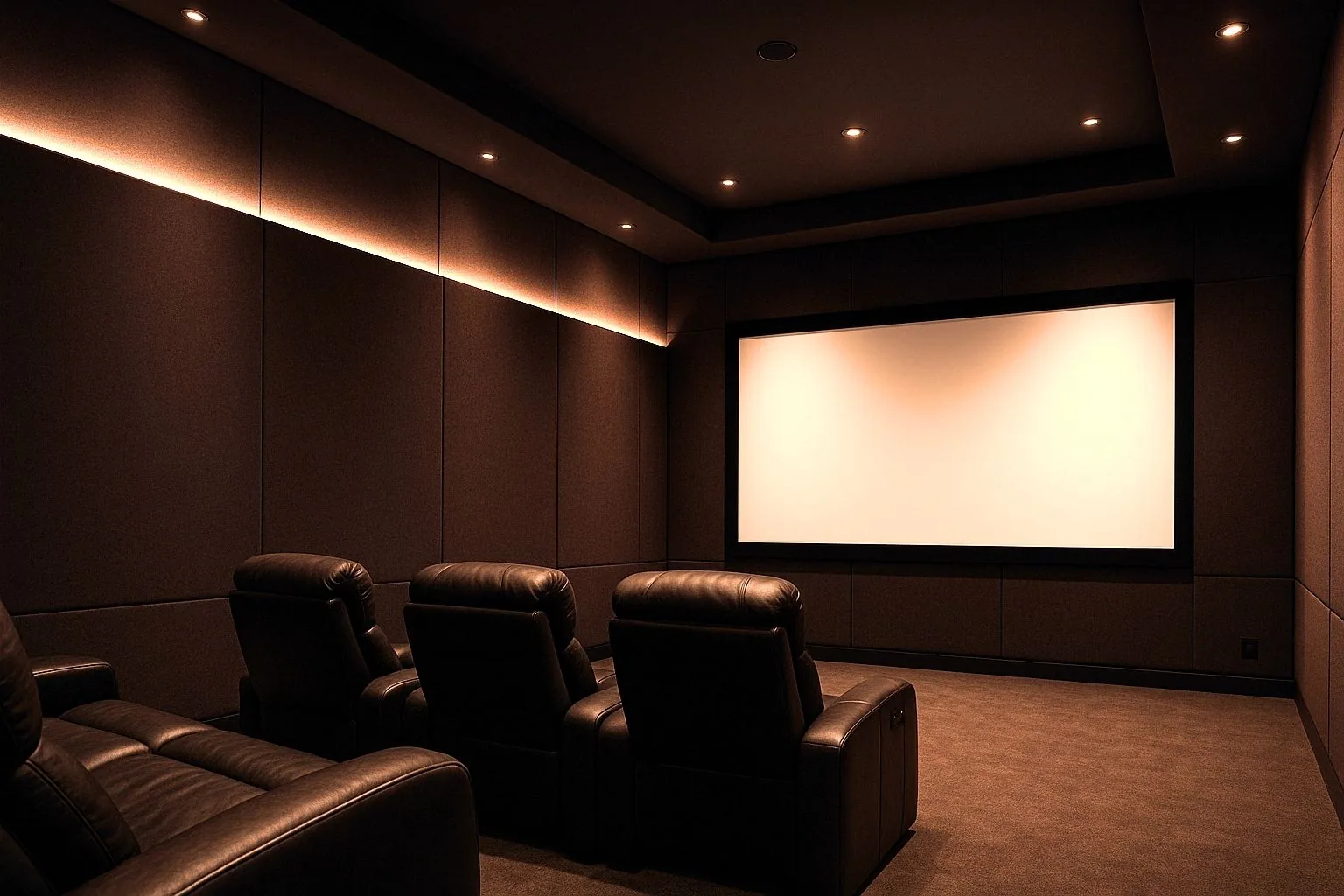
Containment
Bass through the wall, floor and door. Mass and decoupling, with the door usually the weakest point. Pumps, compressors and blowers do not stop, so the noise is constant rather than intermittent. Enclosure at the source is the only answer that holds.
- Soundproofing materials, 2100 kg per cubic metre. 2.5 mm STC 30 at 5.25 kg per sq m, 4 mm STC 34 at 8.4, 6 mm at 12.6
- Soundproof curtains, 10 to 12 mm
- Acoustic carpet and rugs, High density polyester
-
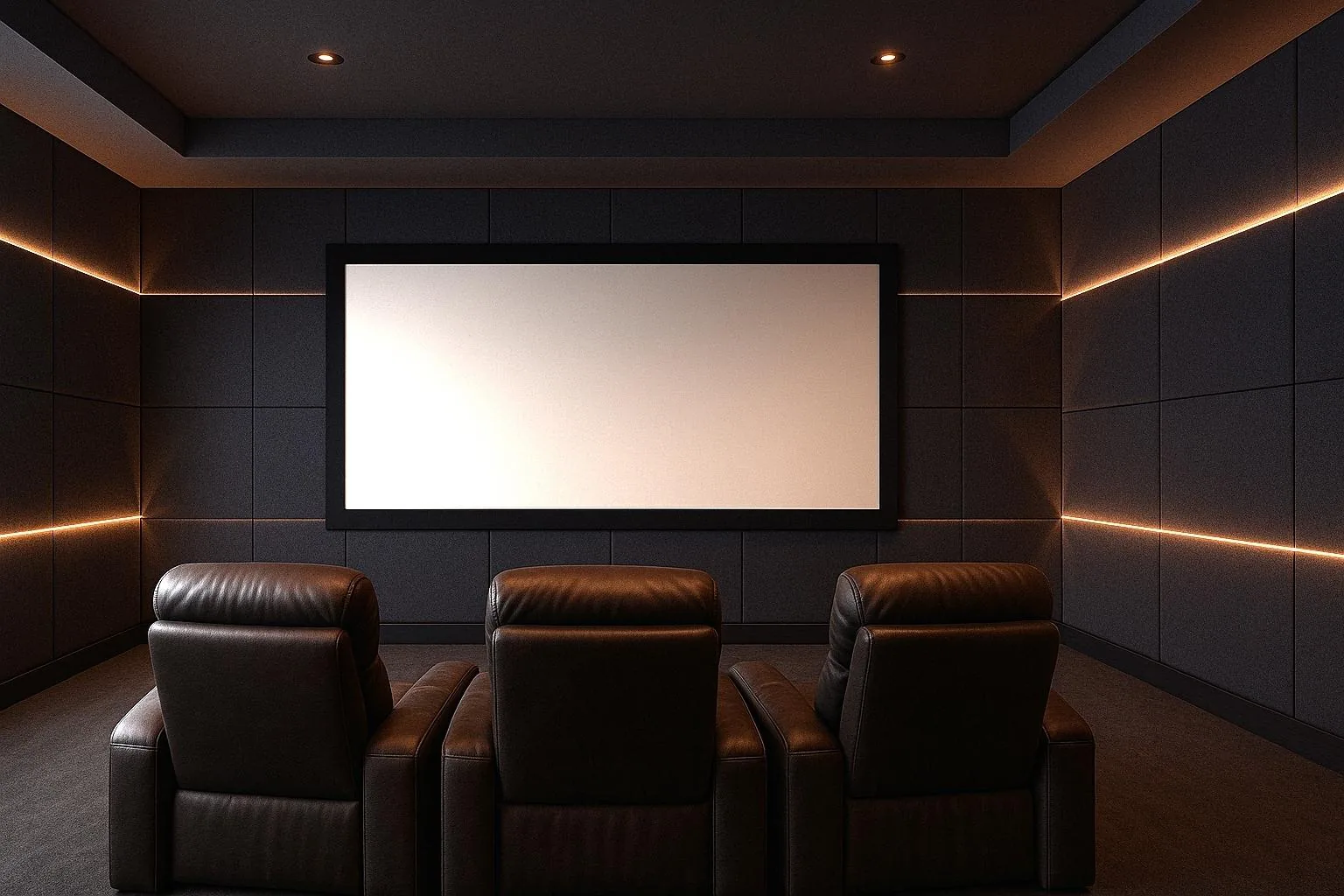
Low frequency inside
Corner absorption with depth, before any surface treatment. Housing sits close to industry here. Containing sound inside the site is a separate design from making the control room usable.
- Soundproofing materials, 1800 x 900 x 20 mm, 100 kg per cubic metre, NRC 0.85
- Soundproof curtains, 5.5 kg per sq m
- Acoustic carpet and rugs, Felt
-
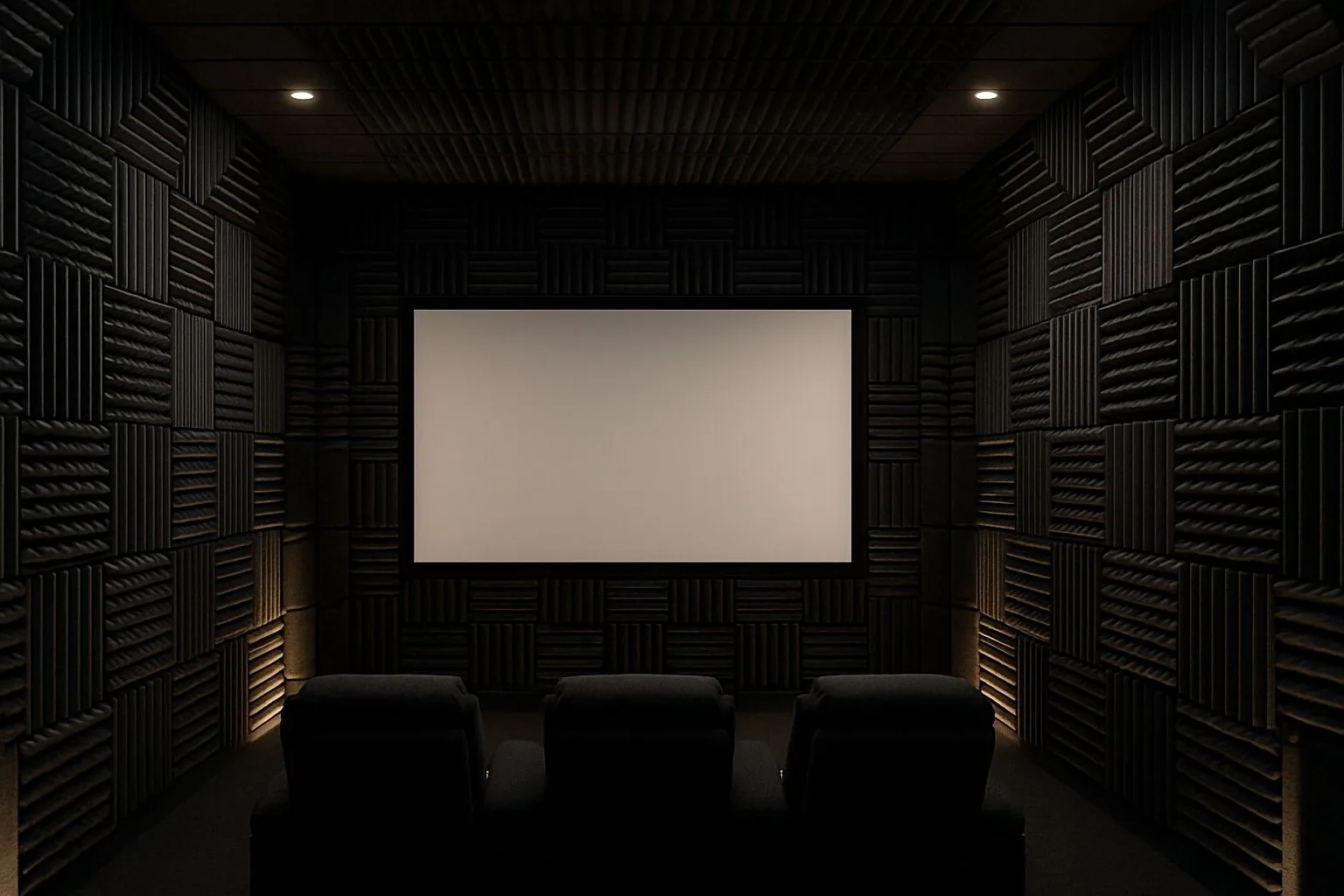
Reflections
Side wall and ceiling first reflection points at the seating position. Operators listening for alarms need background noise down before anything else matters.
- Soundproofing materials, Mass, then decoupling, then cavity absorption, then sealing
- Soundproof curtains, Up to 30 dB
- Acoustic carpet and rugs, 64 sq ft per pack
For a Vapi interior where the finish leads, we will say plainly what each option costs you acoustically. See how we work with interior designers.
04 / Conditions
The Vapi climate decides the material list
Vapi is hot and dry for most of the year, with dust and high daytime surface temperatures, and that narrows the material list before acoustics is discussed.
Dust is the enemy of open-cell products. PET felt does not shed, does not hold dust in the way fabric-wrapped glass wool does, and wipes down. Timber needs a stable indoor RH or it moves.
The failure we design against here is dust ingress and thermal movement in long runs.
Where a consultant is already engaged on a Vapi project, we supply to their specification and send the test reports rather than describing them. More on working with acoustic consultants.
06 / Before you buy
Where this kind of project usually fails
-
Foam on the walls as a soundproofing measure
This is the one that comes back as a second fit-out rather than a snag.
-
A standard door on a room built to hold bass
A 6 mm undercut under a door leaves a hole the size of a brick. The wall around it is then decorative.
-
Treating before the room is sealed
A 6 mm undercut under a door leaves a hole the size of a brick. The wall around it is then decorative.
-
Treating it as a generic Vapi job
Pumps, compressors and blowers do not stop, so the noise is constant rather than intermittent. Enclosure at the source is the only answer that holds.
05 / Supply
Getting it to Vapi, with real dates
| Made at | Our own plant, Palwal, Haryana |
|---|---|
| Reaches site in | three days |
| Dispatch | 2 to 4 working days |
| To site | three days |
| Support | Drawings, build-ups, BOQ and material that arrives complete |
Standard items dispatch in 2 to 4 working days from our plant at Palwal. Grooved panels and custom colours take longer, and we say so before you order, not after.
By road from Palwal, roughly twelve hundred kilometres, normally three days on a dedicated truck.
Questions from Vapi projects
What makes home theatre soundproofing and acoustics different in Vapi?
RC frame apartments and bungalows with stone and tile floors, in dry dusty conditions where open products collect dust. Pumps, compressors and blowers do not stop, so the noise is constant rather than intermittent. Enclosure at the source is the only answer that holds.
Where should the budget go first on a Vapi project?
Containment. Bass through the wall, floor and door. Mass and decoupling, with the door usually the weakest point. Low frequency inside. Corner absorption with depth, before any surface treatment.
Do you have an office or installation team in Vapi?
No. We manufacture in India and supply into Vapi. We give you drawings, build-ups, a BOQ and material that arrives complete, and we will tell you plainly when a job needs a local contractor we cannot be.
How does material get to a Vapi site?
made at: Our own plant, Palwal, Haryana, reaches site in: three days, dispatch: 2 to 4 working days. Standard items dispatch in 2 to 4 working days from our plant at Palwal. Grooved panels and custom colours take longer, and we say so before you order, not after.
What goes wrong most often on this kind of project?
Foam on the walls as a soundproofing measure. A standard door on a room built to hold bass.
What do you need from us to quote?
A plan, a section through the critical partition or ceiling, and what the room is for. From that we can give a build-up and a BOQ rather than a price per square foot.
Next step
Tell us the room, we will tell you the build-up
A plan and a section is enough. We will come back with a build-up, a BOQ and a delivered date, and we will say so if what you are asking for will not work.