
.jpg)
For homes and apartments
Soundproofing and acoustic treatment for homes
Almost every home complaint is one of four things: the wall you share with a neighbour, a bedroom facing a road, footsteps from the flat above, or a room inside the house that has to be quiet while the rest of it is not. They are different problems, and panels on the wall only solve the last one.
- Party wall and window wall
- SoundBlanket® MLV, STC 34 at 4 mm
- Impact and bass
- BassBloc® NRC 0.85 at 20 mm, carpet tiles 4 mm
- Room finish
- PET felt NRC 0.30 to 0.60, 40+ colours, 3 to 7 days
- One room at a time
- Small quantities through the online store
Send the room dimensions, which wall or ceiling the noise comes through, and what the existing construction is. For a single room you can also buy panels, seals and curtains directly from the online store. We manufacture and specify; we do not carry out on site measurement, consultancy or installation ourselves.
01 / What actually goes wrong
Four problems that get treated with the same product by mistake
Absorption inside a room and isolation between two spaces are different purchases. Knowing which of the four you have decides what you should buy first, and usually saves most of the budget.
-
The party wall with the neighbour
A single leaf brick or block wall shared with the next flat, often with sockets and a TV unit back to back on either side of it. Voices and television arrive through the wall because it has no mass to spare and no cavity. Adding a decorative panel to your face of it changes nothing. What changes it is a new leaf in front of the existing wall: a dense barrier, a filled cavity and a board face, sealed at the edges, the ceiling line and the sockets.
-
A bedroom over a road
Traffic noise almost always comes in through the window and the gaps around it rather than through the wall, so the window is the element to fix first. Sealing the openable joint and hanging a heavy curtain over the opening is the fastest improvement available in a finished flat, and it can be done in an afternoon. Heavier glazing is a separate purchase from a glazing supplier; we make the seals and the curtains, not the window.
-
Footsteps from the flat above
Footfall is impact noise: the structure is struck directly, and the slab then radiates into your ceiling. It is the hardest home problem to solve from below, because the only complete fix is a soft floor or a resilient layer on the neighbour's side. From your own side, a barrier above a new false ceiling with an absorber in the void reduces it, and nobody should promise you it removes it.
-
A room inside the home that has to behave differently
A home office where calls have to be private, a music room or theatre that must not carry through the house, a study that needs to be free of the kitchen. Here you are isolating room from room inside your own home, and a hollow internal door with a 10 mm undercut is normally the loudest part of that wall. Hard tiled, glazed, open-plan interiors add a second issue: the room returns so much energy that ordinary conversation becomes tiring.
02 / The build-up
Seal first, then build the wall in three layers
In a finished home the order of spending matters, because the first step is cheap and often gets you most of the way.
-
First: the leaks
Door undercuts, the openable joint of a window, the gap around an air conditioner sleeve and unsealed sockets and conduit boxes pass a surprising amount for how little they cost to close. Do this before any panelling, because it improves a finished room immediately and it also tells you how much of the noise was actually coming through the wall.
- Perimeter and bottom door seals, silicone and EPDM, 6 x 6 mm D-profile, 18 ft per roll
- Silicone bottom seal, 920 x 15 mm, for doors up to 3 ft wide
- Soundproof curtain, STC 30, over a window or an opening, hook hung
-
Layer 1: the barrier
A dense membrane fixed to the existing wall or above the new ceiling line. This is the layer that reduces what passes through, and it works by mass, so it has to be continuous and sealed at every edge and penetration. SoundBlanket® MLV: STC 30 at 2.5 mm, STC 34 at 4 mm to ASTM E90, 2100 kg/m³, Class A surface burning to ASTM E84, sheets 8 x 4, 16 x 4 and 32 x 4 ft, dispatched in 2 to 5 days in India.
-
Layer 2: the cavity absorber
The layer inside the new build-up, which absorbs low frequency energy and damps the new leaf so it does not behave like a drum. It also handles the part a thin panel cannot: subwoofers, a washing machine, traffic rumble. BassBloc®: NRC 0.85 at 20 mm, 0.95 at 40 mm to ASTM C423, effective 100 to 500 Hz, 100 kg/m³, 1800 x 900 mm rolls. It must always be covered and never left exposed in a room.
-
Layer 3: the finish
The visible face, and the only layer that changes how the room sounds inside. This is where the choice is aesthetic as much as acoustic: PET felt panels NRC 0.30 at 9 mm to 0.60 at 24 mm and 0.90 over 20 mm BassBloc®, wooden slats NRC 0.75, fluted panels NRC 0.60 in oak veneer, printed felt for a child's room.
Layer order by surface
| Surface | From the structure inwards | What it is for |
|---|---|---|
| Party wall with a neighbour | SoundBlanket® 4 mm on the existing wall, BassBloc® 20 mm in the new cavity, board, then PET felt or wooden panels | Voices and television through a single leaf wall |
| Bedroom window on a road | Seal the openable joint, then a soundproof curtain over the opening, acoustic curtains for reflections | The route traffic noise actually uses |
| Ceiling under the flat above | SoundBlanket® above the new ceiling, BassBloc® in the void, felt tiles or baffles on the visible face | Reduces footfall reaching you; does not remove it |
| Your own floor, over the flat below | BassBloc® 20 mm under the floor finish, acoustic carpet tiles on top | Your footfall and furniture, going down |
| Internal door to a study or theatre | Solid core leaf, perimeter seal, bottom seal | Usually the loudest part of an internal wall |
| Open-plan living and dining | PET felt panels or wooden slats on one or two walls, felt clouds over the dining table | Echo and harshness, not transfer |
| Home theatre or music room | Barrier and cavity absorber on every surface, bass traps in the corners, absorption at the first reflections | Isolation first, then tuning the room |
For a single room, panels, seals, curtains and adhesive can be ordered in small quantities from the online store.
03 / Room by room
What to do in each room, and in what order
-

Bedrooms
The room where the road and the neighbour both matter, and where the fix is nearly always the window and the wall rather than the decor. Seal the window joint and the door, hang a heavy curtain, and only build out the wall if the noise is still coming through it. If the bedroom sits under another flat, the ceiling is a separate job with a limited outcome.
- Soundproof curtain, STC 30, over the window opening
- Perimeter and bottom seals on the bedroom door
- SoundBlanket® 4 mm on the road or party wall, with BassBloc® 20 mm in the cavity
- Reducing traffic noise in a city home and how to soundproof a bedroom
-

Living rooms and the shared wall
Two jobs in one room. The wall shared with the next flat needs a barrier build-up; the room itself, if it is tiled, glazed and open-plan, needs absorption so conversation and television stop sounding harsh. Treating one or two walls and the area over the seating is usually enough, and covering every surface makes the room sound dead rather than better.
- SoundBlanket® 4 mm plus BassBloc® 20 mm on the party wall
- Wooden slats, NRC 0.75, 2440 x 192 mm, as a feature wall
- PET felt panels, NRC up to 0.60, in 40+ colours
- Felt clouds over the seating or the dining table
- Soundproofing a shared apartment wall
-

Home theatre and music room
The only room in a house where low frequency is the design problem. Bass moves through the slab and the studwork rather than through the air, so the build-up has to be on every surface including the floor, and the corners need traps. Panels alone will improve how it sounds inside and do nothing for the rest of the house.
- SoundBlanket® 4 mm on walls and above the ceiling
- BassBloc® 20 mm in the cavity and under the floor finish
- Bass Trap Mega, NRC 1.0, 178 mm corner profile
- Galaxy foam, NRC 0.95 at 50 mm, at the first reflection points
- Full detail on the home theatre page
-
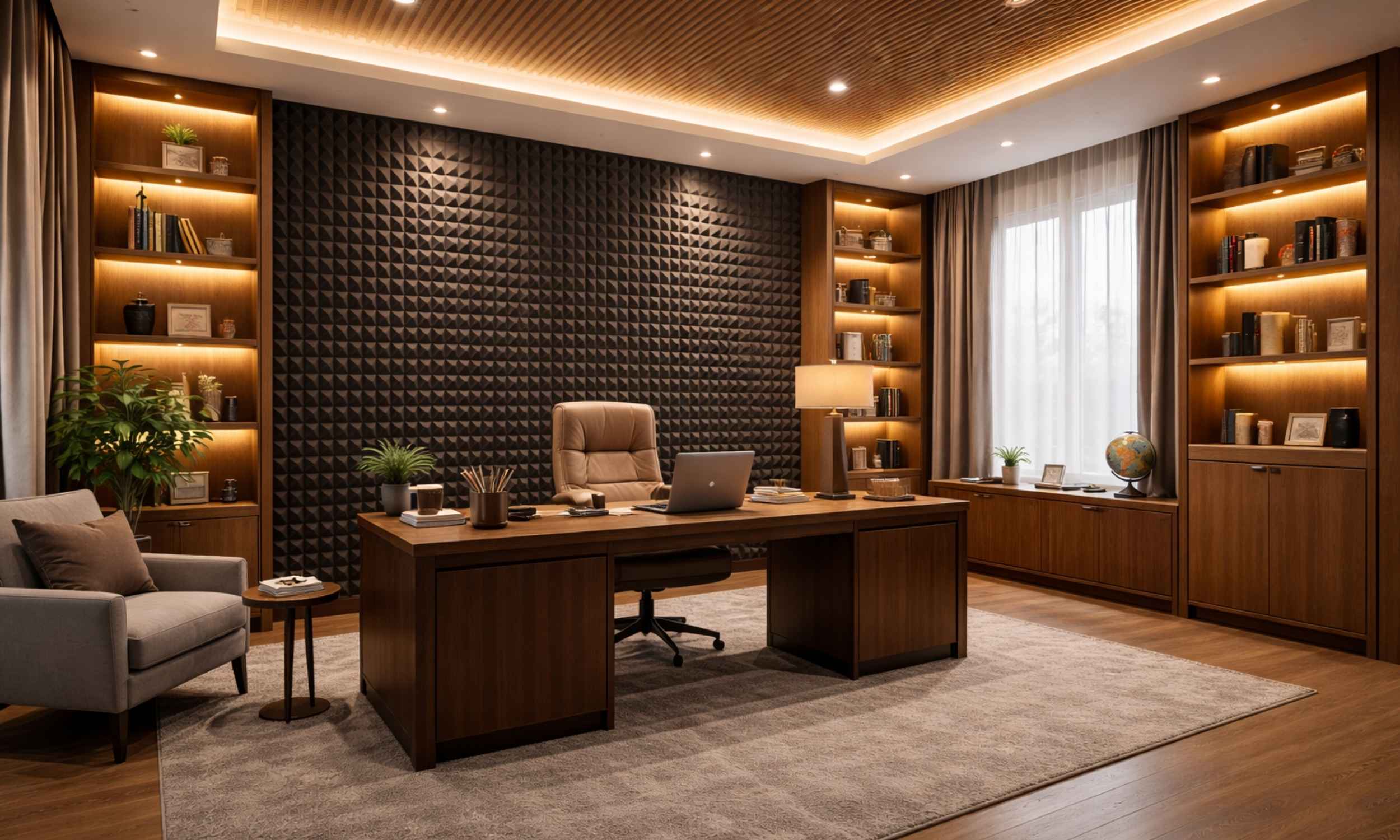
Home office and study
A working room inside a lived-in house, so it needs both privacy out and quiet in. The door is the first purchase, absorption behind the desk and on the wall the microphone faces is the second, and it makes a measurable difference to how you sound on a call. A child's study room is the same job with a softer finish.
- Door seals on a solid core leaf
- PET felt panels, NRC 0.30 to 0.60, behind and beside the desk
- Fabric faced panels or printed felt where the wall is on camera
- Soundproofing a home office and a child's study room
-
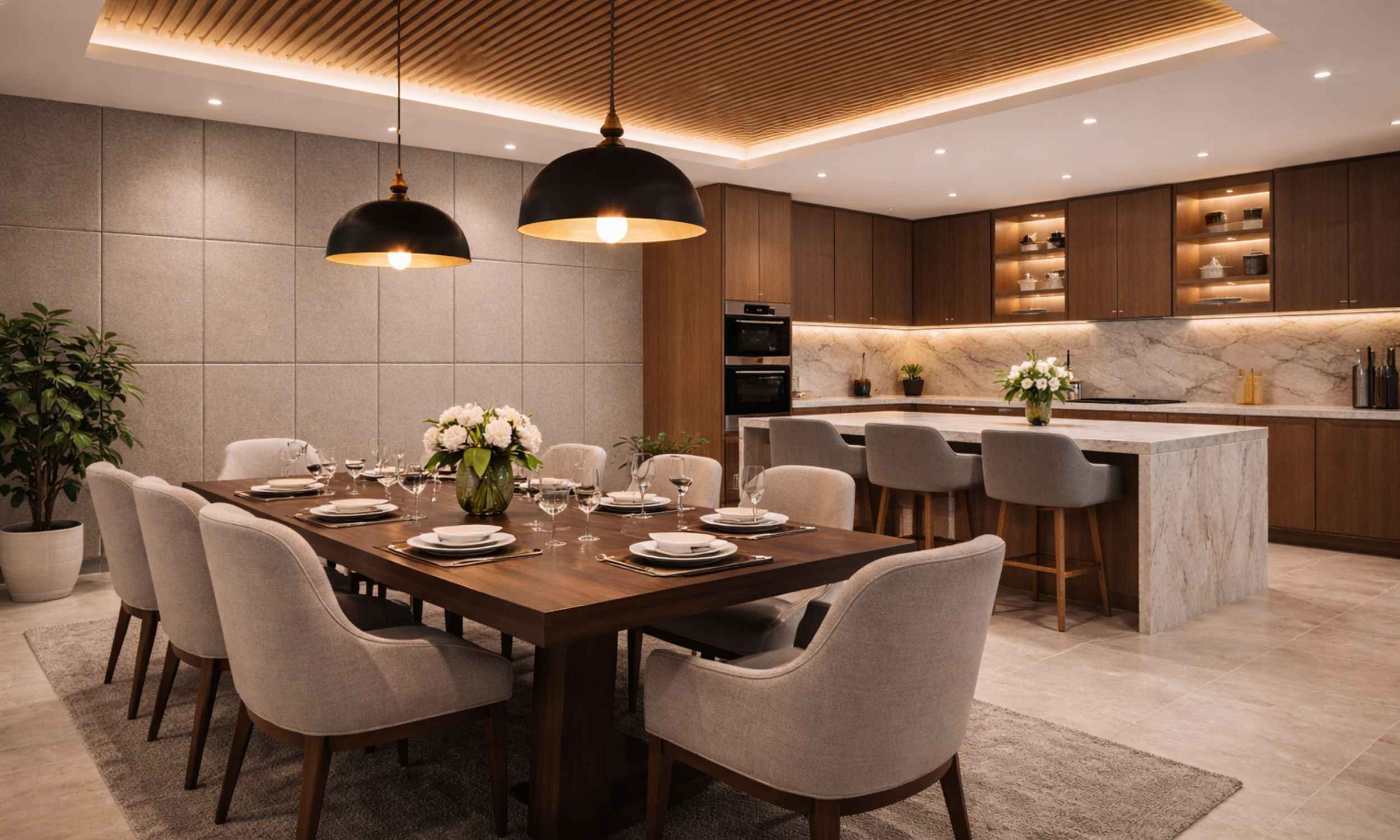
Kitchen and dining
Hard by necessity: tile, stone, glass and steel, with a chimney and appliances running. The noise is mostly the room returning its own clatter, so a small amount of absorption in the right place is what makes conversation at the table comfortable. Anything used here has to be cleanable, which rules out an exposed soft absorber.
- Felt clouds or baffles over the dining table
- PET felt panels, wipeable, on the dining wall
- Acoustic carpet tiles, 4 mm, 500 x 500 mm, in the adjoining room
- Acoustic curtains, NRC up to 0.70, 500 GSM, at a glazed wall
04 / What we see go wrong
Six things homeowners buy that do not fix the problem
-
Foam on the wall for a neighbour problem
Absorption changes what your own room returns, not what passes through the wall. The neighbour will be exactly as audible the next evening.
-
Panelling the wall while the window stays open at the joint
In most road facing bedrooms the window and its gaps are the main path. Sealing it costs a fraction of panelling the wall and does more.
-
Expecting a ceiling to remove footfall
Impact noise is put into the structure above you. Treating your ceiling reduces it; only a soft floor or resilient layer upstairs deals with it properly.
-
Decorative foam bought as acoustic foam
Low density profile foam with no published NRC and no fire rating. It photographs well and changes almost nothing you can hear.
-
The internal door left as it is
A hollow leaf with a 10 mm undercut is the loudest part of most internal walls in a home, and the cheapest element on the whole list to improve.
-
Absorber left exposed
BassBloc® is a cavity product and must always be covered by a board or panel face. Left exposed in a room it collects dust and damages easily.
05 / Specifications
Tested performance, with the standard it was measured to
| Product | Tested performance | Test standard |
|---|---|---|
| SoundBlanket mass loaded vinyl | STC 30 at 2.5 mm, STC 34 at 4 mm; 2100 kg/m³ | ASTM E90 |
| Echsorbix PET felt panels | NRC 0.30 at 9 mm, 0.40 at 12 mm, 0.50 at 18 mm, 0.60 at 24 mm | ASTM C423 / EN ISO 354 |
| BassBloc low-frequency absorber | NRC 0.85 at 20 mm, 0.95 at 40 mm; 100 kg/m³ | ASTM C423 |
| MMT Acoustix acoustic foam | NRC 0.90 at 50 mm (Pyramid); 0.95 at 50 mm (Galaxy) | ASTM C423 |
| SoundaXe wooden acoustic panels | NRC 0.75 (slats); 0.70 (perforated); 0.60 (fluted, 18 mm) | ASTM C423 |
| Soundproof curtains | STC 30, NRC 0.20, 4500 GSM; up to 30 dB reduction | ASTM E90 / C423 |
| Acoustic carpet | Indicative NRC 0.25 (in-house figure) | In-house measurement |
NRC and STC are the figures we publish and stand behind, and the acoustic carpet figure is an in-house measurement rather than a third party test. How much quieter a particular room becomes depends on its construction and is not something we can state from a product figure. The full set of reports is listed on the certifications page.
06 / How we can help
What we do, and what we do not
-
We do
- Manufacture every layer above at the Palwal plant, Haryana
- Recommend a build-up and quantities from your room dimensions and a photograph of the wall, usually within 48 hours
- Sell single room quantities of panels, seals, curtains and adhesive through the online store
- Make panels to size, in 40+ colours, with printing and CNC cutting for a specific interior
-
We do not
- Visit site, measure noise levels or provide acoustic consultancy
- Supply windows, glazing or doors. We make the seals, curtains and panels
- Install. We manufacture and supply the materials
-
We refer
We work with associated acoustic consultants and installers across India. If your build-up needs verifying, or you want the work carried out rather than supplied, ask us when you send the room details and we will put you in touch with someone near you.