

For projects in Cape Town
School and classroom acoustics in Cape Town
Hard floors, bare walls and long corridors that amplify everything. Children with developing language, and anyone with a hearing difficulty, lose more from a live classroom than adults do, which is why intelligibility is the target rather than quiet. Classrooms are hard walled with high ceilings and large class sizes, and school halls double as assembly and performance spaces.
- Classroom RT
- A number, set against room volume, achieved mostly at the ceiling.
- Corridor spill
- Long hard circulation feeds every room off it. Treating the corridor helps every classroom at once.
- Halls and gyms
- Dual use rooms carrying speech, music and sport, where durability decides the product.
- Quote
- From a plan and a section, within 48 hours
01 / Start here
The product, described honestly, for a Cape Town brief
Hard floors, bare walls and long corridors that amplify everything. Children with developing language, and anyone with a hearing difficulty, lose more from a live classroom than adults do, which is why intelligibility is the target rather than quiet.
Classrooms are hard walled with high ceilings and large class sizes, and school halls double as assembly and performance spaces.
Work reaching us from Cape Town is mostly hotels and restaurants, heritage conversions, offices, apartments, schools, studios.
- The port is at the city Direct sea into Cape Town avoids the long inland haul, which makes the landed cost and the date both easier to hold.
- Heritage fabric stays put Older buildings in the city cannot be structurally altered. Work has to be internal, shallow and ideally reversible.
- Hospitality is the market Hotels and restaurants where the room is part of what the guest is paying for, judged when it is completely full.
- Classroom RT A number, set against room volume, achieved mostly at the ceiling.
Full specification
Thickness, density, NRC by frequency, fire class, standard sizes and build-up detail for school acoustics are on the main product page. This page covers what that means for a project in Cape Town.
02 / The build-up
How the layers stack, from the structure inwards
-

Layer 1
Wood wool acoustic panels
Wood fibre bound into a rigid board with an open texture. In Cape Town, split units and generator sets, with backup generation running often enough that its enclosure matters as much as the HVAC.
Direct fix. Mechanically fixed to the soffit or wall. Durable and simple.
-

Layer 2
Acoustic panels
The full absorber range rather than one product: plain PET felt, printed felt, grooved panels and fabric finishes, chosen by how the room is used and how it has to look. In Cape Town, church buildings and community halls are large hard rooms carrying amplified music and speech at high level.
Wall array. Panels placed at first reflection points rather than spread evenly. Fewer panels, better result.
-

Layer 3
Acoustic carpet and rugs
A tile carpet with a dense polyester face on a felt backing. In Cape Town, classrooms are hard walled with high ceilings and large class sizes, and school halls double as assembly and performance spaces.
Zoned. Carpet in the circulation and meeting zones, hard floor elsewhere, so the treatment sits where the noise is made.
For a Cape Town practice, the useful thing is a detail you can put in a drawing set, not a brochure. See how we support architects.
03 / In this market
What decides the build-up in Cape Town
- The port is at the city
Direct sea into Cape Town avoids the long inland haul, which makes the landed cost and the date both easier to hold.
- Heritage fabric stays put
Older buildings in the city cannot be structurally altered. Work has to be internal, shallow and ideally reversible.
- Hospitality is the market
Hotels and restaurants where the room is part of what the guest is paying for, judged when it is completely full.
- Wind and coastal damp
PET felt does not absorb moisture or feed mould, which matters on exposed coastal elevations.
- Assembly and performance rooms
Church buildings and community halls are large hard rooms carrying amplified music and speech at high level.
- School and campus buildings
Classrooms are hard walled with high ceilings and large class sizes, and school halls double as assembly and performance spaces.
04 / Room by room
Room by room, on a typical Cape Town job
-

Classroom RT
A number, set against room volume, achieved mostly at the ceiling. Direct sea into Cape Town avoids the long inland haul, which makes the landed cost and the date both easier to hold.
- PET felt acoustic panels, 100% PET non-woven, no added binder
- Acoustic panels, 1800 x 900 mm, image printed into the felt rather than onto a facing
- Acoustic carpet and rugs, High density polyester
-

Corridor spill
Long hard circulation feeds every room off it. Treating the corridor helps every classroom at once. Older buildings in the city cannot be structurally altered. Work has to be internal, shallow and ideally reversible.
- PET felt acoustic panels, 9, 12, 18 and 24 mm standard, tolerance plus or minus 5 percent
- Acoustic panels, Cut pattern in PET felt, adds visual rhythm without changing the absorber
- Acoustic carpet and rugs, Felt
-
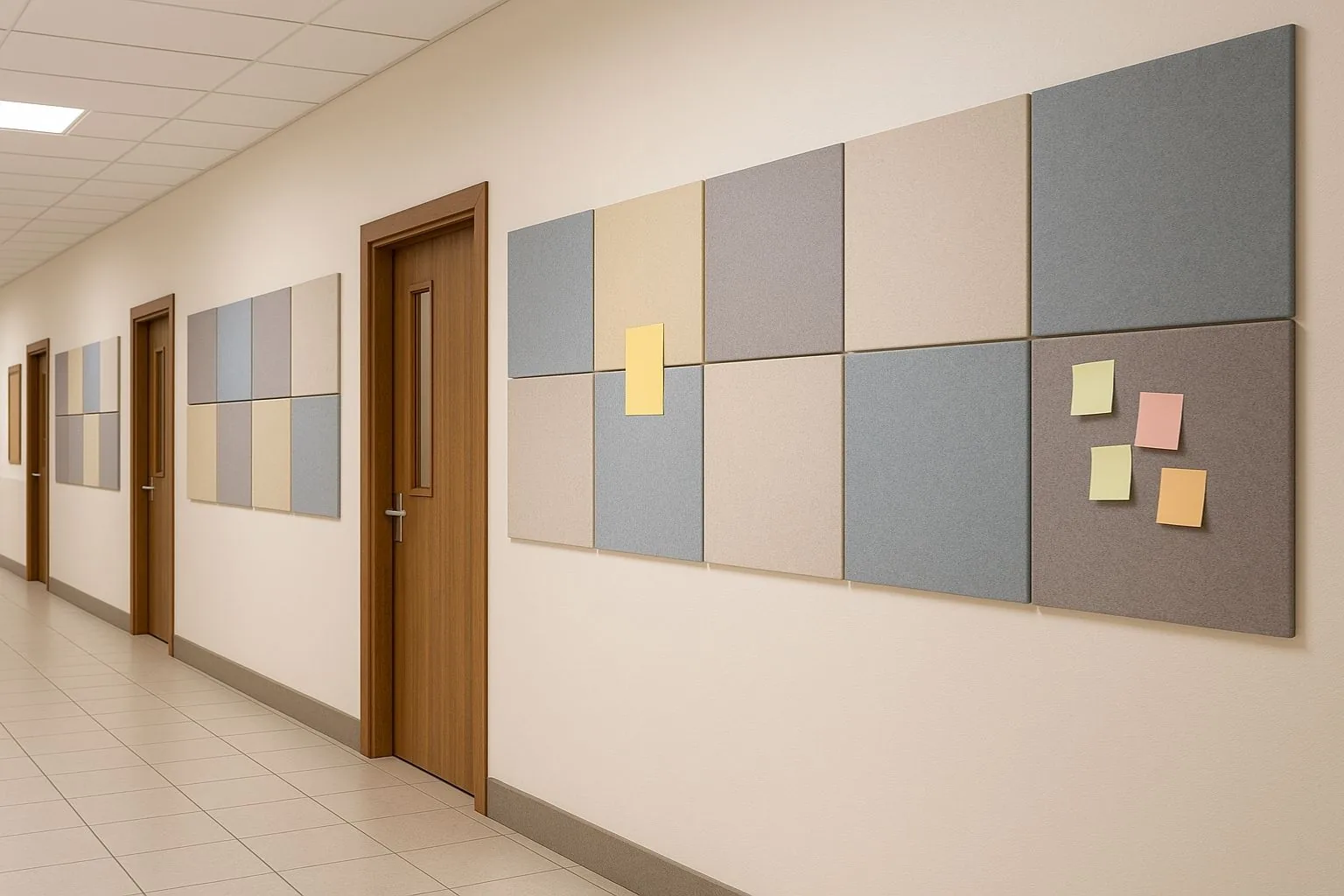
Halls and gyms
Dual use rooms carrying speech, music and sport, where durability decides the product. Hotels and restaurants where the room is part of what the guest is paying for, judged when it is completely full.
- PET felt acoustic panels, 4 to 24 mm
- Acoustic panels, ASTM C423
- Acoustic carpet and rugs, 64 sq ft per pack
Designers get colour, pattern and CNC options with the absorption figure attached to each. See how we work with interior designers.
04 / Climate and durability
Durability in Cape Town, before acoustics is discussed
Cape Town is hot summers, mild winters and a distinct wet season, and that narrows the material list before acoustics is discussed.
PET felt handles the wet months without absorbing moisture or feeding mould. Timber and wood wool want a ventilated cavity and a stable indoor RH.
The failure we design against here is wet-season humidity behind linings.
Where a consultant is already engaged on a Cape Town project, we supply to their specification and send the test reports rather than describing them. More on working with acoustic consultants.
06 / Before you buy
What we watch go wrong on jobs like this
-
Panels at child height where they get damaged
It sounds like a small detail until the room is finished and the complaint arrives.
-
Treating one classroom and leaving the corridor
This is the one that comes back as a second fit-out rather than a snag.
-
Choosing a product that cannot take a football
Noise with a source is fixed at the source. Treating the receiving room is the expensive way to get a small result.
-
Treating it as a generic Cape Town job
Direct sea into Cape Town avoids the long inland haul, which makes the landed cost and the date both easier to hold.
05 / Supply
Getting it to Cape Town, with real dates
| Ships from | Palwal, Haryana, India |
|---|---|
| Arrives at | Cape Town, then a short road run to site |
| Dispatch | 4 to 7 working days |
| Freight | Sea into Cape Town |
| Support | Drawings, build-ups, BOQ and material that arrives complete |
Standard items dispatch in 4 to 7 working days. Grooved panels and custom colours take longer, and we say so before you order, not after.
Sea freight direct into Cape Town, then a short road run to site. Air freight for samples and urgent quantities.
Questions from Cape Town projects
What makes school and classroom acoustics different in Cape Town?
Classrooms are hard walled with high ceilings and large class sizes, and school halls double as assembly and performance spaces. Direct sea into Cape Town avoids the long inland haul, which makes the landed cost and the date both easier to hold.
Where should the budget go first on a Cape Town project?
Classroom RT. A number, set against room volume, achieved mostly at the ceiling. Corridor spill. Long hard circulation feeds every room off it. Treating the corridor helps every classroom at once.
Do you have an office or installation team in Cape Town?
No. We manufacture in India and supply into Cape Town. We give you drawings, build-ups, a BOQ and material that arrives complete, and we will tell you plainly when a job needs a local contractor we cannot be.
How does material get to a Cape Town site?
ships from: Palwal, Haryana, India, arrives at: Cape Town, then a short road run to site, dispatch: 4 to 7 working days. Standard items dispatch in 4 to 7 working days. Grooved panels and custom colours take longer, and we say so before you order, not after.
What goes wrong most often on this kind of project?
Panels at child height where they get damaged. Treating one classroom and leaving the corridor.
What do you need from us to quote?
A plan, a section through the critical partition or ceiling, and what the room is for. From that we can give a build-up and a BOQ rather than a price per square foot.
Next step
Send the drawings, get a straight answer
One drawing gets you a proper answer. Build-up, quantities, a delivered date, and an honest note on anything we think is the wrong approach.