

For projects in Cape Town
Cinema and multiplex soundproofing in Cape Town
Screens stacked beside and above each other, each running full range at high level. Bleed between auditoria is the failure everyone hears, and it is decided by the shell, not the finishes. Church buildings and community halls are large hard rooms carrying amplified music and speech at high level.
- Screen to screen
- Independent construction between auditoria, with services broken at the line.
- In room response
- Heavy absorption on side and rear walls so the mix is heard as intended.
- Plant and projection
- Equipment noise into the auditorium, treated at source.
- Quote
- From a plan and a section, within 48 hours
01 / The product
What this is, and what it changes in a Cape Town room
Screens stacked beside and above each other, each running full range at high level. Bleed between auditoria is the failure everyone hears, and it is decided by the shell, not the finishes.
Church buildings and community halls are large hard rooms carrying amplified music and speech at high level.
Work reaching us from Cape Town is mostly hotels and restaurants, heritage conversions, offices, apartments, schools, studios.
- The port is at the city Direct sea into Cape Town avoids the long inland haul, which makes the landed cost and the date both easier to hold.
- Heritage fabric stays put Older buildings in the city cannot be structurally altered. Work has to be internal, shallow and ideally reversible.
- Hospitality is the market Hotels and restaurants where the room is part of what the guest is paying for, judged when it is completely full.
- Screen to screen Independent construction between auditoria, with services broken at the line.
Full specification
Thickness, density, NRC by frequency, fire class, standard sizes and build-up detail for cinema soundproofing are on the main product page. This page covers what that means for a project in Cape Town.
02 / The build-up
What goes where, from the structure in
-

Layer 1
SoundBlanket mass loaded vinyl
A limp, high density sheet that adds mass to a partition, floor or duct without adding depth. In Cape Town, split units and generator sets, with backup generation running often enough that its enclosure matters as much as the HVAC.
Wall, decoupled. Independent stud, membrane between the boards, cavity absorption, two boards. The membrane is one part of a system, never the whole answer.
-

Layer 2
Acoustic panels
The full absorber range rather than one product: plain PET felt, printed felt, grooved panels and fabric finishes, chosen by how the room is used and how it has to look. In Cape Town, church buildings and community halls are large hard rooms carrying amplified music and speech at high level.
Wall array. Panels placed at first reflection points rather than spread evenly. Fewer panels, better result.
-

Layer 3
PET felt acoustic panels
A rigid non-woven panel pressed from 100% polyester fibre, a large part of it recycled. In Cape Town, classrooms are hard walled with high ceilings and large class sizes, and school halls double as assembly and performance spaces.
On a 25 to 50 mm air gap. The same panel on battens. The air gap moves absorption down in frequency at no extra material cost, and is the cheapest improvement available.
We would rather argue about the build-up at design stage than on site. See how we support architects.
03 / On the ground
What decides the build-up in Cape Town
- The port is at the city
Direct sea into Cape Town avoids the long inland haul, which makes the landed cost and the date both easier to hold.
- Heritage fabric stays put
Older buildings in the city cannot be structurally altered. Work has to be internal, shallow and ideally reversible.
- Hospitality is the market
Hotels and restaurants where the room is part of what the guest is paying for, judged when it is completely full.
- Wind and coastal damp
PET felt does not absorb moisture or feed mould, which matters on exposed coastal elevations.
- Assembly and performance rooms
Church buildings and community halls are large hard rooms carrying amplified music and speech at high level.
04 / Room by room
Where the money goes on a Cape Town project
-
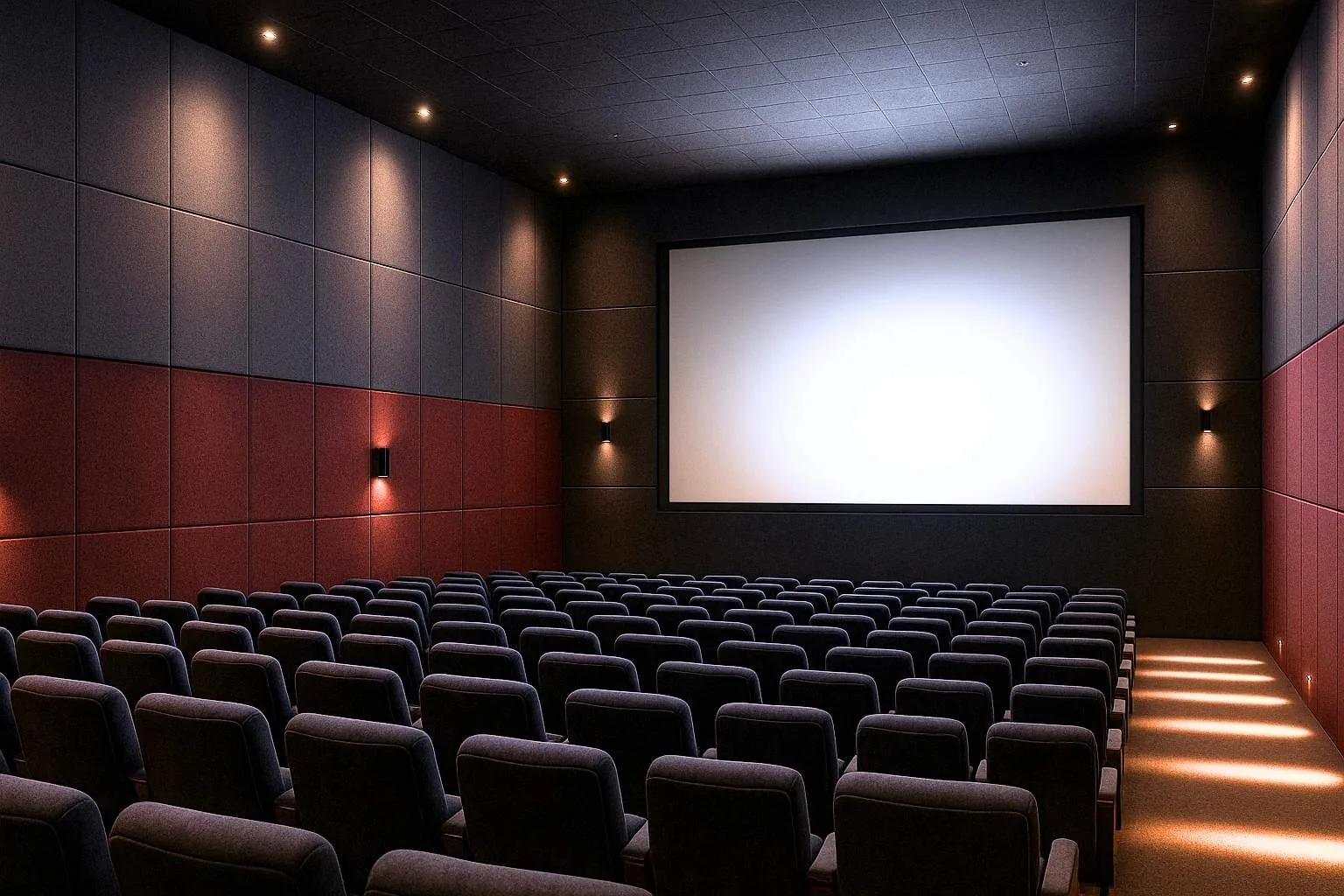
Screen to screen
Independent construction between auditoria, with services broken at the line. Direct sea into Cape Town avoids the long inland haul, which makes the landed cost and the date both easier to hold.
- Soundproofing materials, 2100 kg per cubic metre. 2.5 mm STC 30 at 5.25 kg per sq m, 4 mm STC 34 at 8.4, 6 mm at 12.6
- Acoustic panels, 1800 x 900 mm, image printed into the felt rather than onto a facing
- Acoustic carpet and rugs, High density polyester
-
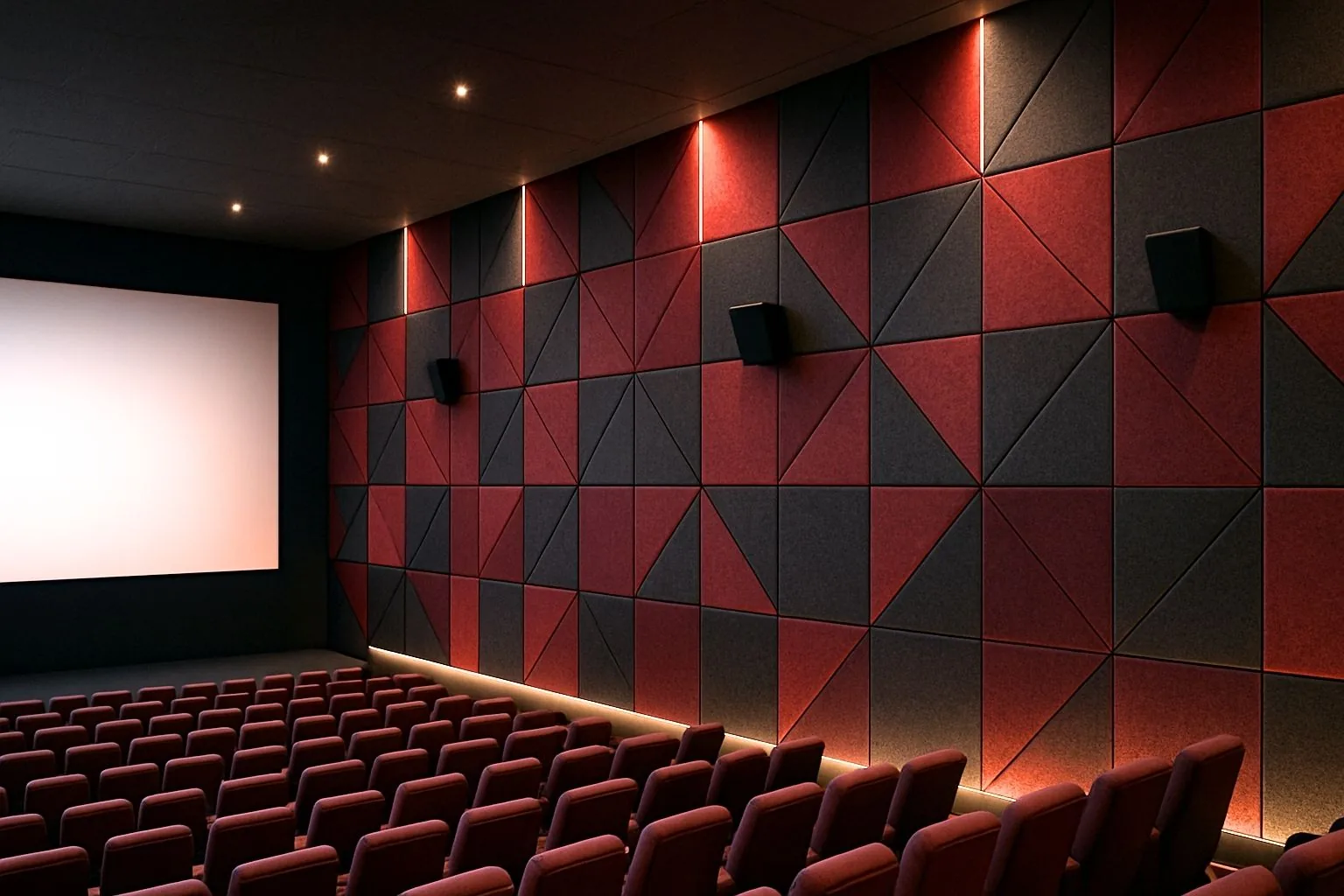
In room response
Heavy absorption on side and rear walls so the mix is heard as intended. Older buildings in the city cannot be structurally altered. Work has to be internal, shallow and ideally reversible.
- Soundproofing materials, 1800 x 900 x 20 mm, 100 kg per cubic metre, NRC 0.85
- Acoustic panels, Cut pattern in PET felt, adds visual rhythm without changing the absorber
- Acoustic carpet and rugs, Felt
-
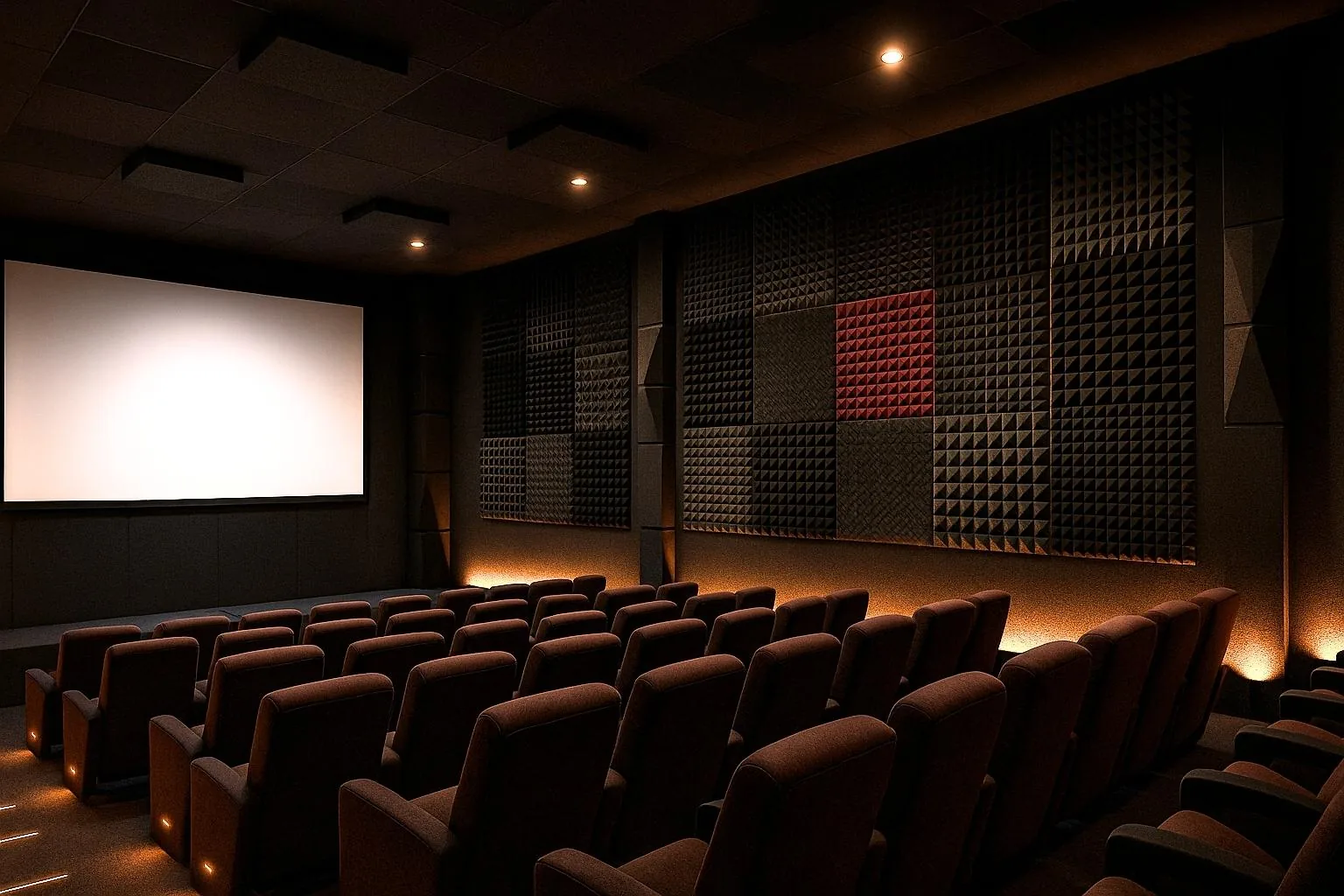
Plant and projection
Equipment noise into the auditorium, treated at source. Hotels and restaurants where the room is part of what the guest is paying for, judged when it is completely full.
- Soundproofing materials, Mass, then decoupling, then cavity absorption, then sealing
- Acoustic panels, ASTM C423
- Acoustic carpet and rugs, 64 sq ft per pack
If the visual is fixed and the room still has to perform, that is a solvable problem and a conversation worth having early. See how we work with interior designers.
04 / Durability
What the Cape Town climate rules in and rules out
Cape Town is hot summers, mild winters and a distinct wet season, and that narrows the material list before acoustics is discussed.
PET felt handles the wet months without absorbing moisture or feeding mould. Timber and wood wool want a ventilated cavity and a stable indoor RH.
The failure we design against here is wet-season humidity behind linings.
Where a consultant is already engaged on a Cape Town project, we supply to their specification and send the test reports rather than describing them. More on working with acoustic consultants.
06 / Before you buy
What we watch go wrong on jobs like this
-
A shared service void running across the wall line
Square metre for square metre the ceiling is the cheapest result in the room. Skipping it and buying wall panels instead is the most common way to overspend.
-
Treating the auditorium to fix bleed from the next screen
Small on the drawing, expensive on site, and almost always found after handover.
-
Doors and lobbies specified late and undersized
Soundproofing fails at the gaps, not the materials. One unsealed service penetration can undo a correctly built wall.
-
Treating it as a generic Cape Town job
Direct sea into Cape Town avoids the long inland haul, which makes the landed cost and the date both easier to hold.
05 / Logistics
Supply into Cape Town, start to site
| Ships from | Palwal, Haryana, India |
|---|---|
| Arrives at | Cape Town, then a short road run to site |
| Dispatch | 4 to 7 working days |
| Freight | Sea into Cape Town |
| Support | Drawings, build-ups, BOQ and material that arrives complete |
Standard items dispatch in 4 to 7 working days. Grooved panels and custom colours take longer, and we say so before you order, not after.
Sea freight direct into Cape Town, then a short road run to site. Air freight for samples and urgent quantities.
Questions from Cape Town projects
What makes cinema and multiplex soundproofing different in Cape Town?
Church buildings and community halls are large hard rooms carrying amplified music and speech at high level. Direct sea into Cape Town avoids the long inland haul, which makes the landed cost and the date both easier to hold.
Where should the budget go first on a Cape Town project?
Screen to screen. Independent construction between auditoria, with services broken at the line. In room response. Heavy absorption on side and rear walls so the mix is heard as intended.
Do you have an office or installation team in Cape Town?
No. We manufacture in India and supply into Cape Town. We give you drawings, build-ups, a BOQ and material that arrives complete, and we will tell you plainly when a job needs a local contractor we cannot be.
How does material get to a Cape Town site?
ships from: Palwal, Haryana, India, arrives at: Cape Town, then a short road run to site, dispatch: 4 to 7 working days. Standard items dispatch in 4 to 7 working days. Grooved panels and custom colours take longer, and we say so before you order, not after.
What goes wrong most often on this kind of project?
A shared service void running across the wall line. Treating the auditorium to fix bleed from the next screen.
What do you need from us to quote?
A plan, a section through the critical partition or ceiling, and what the room is for. From that we can give a build-up and a BOQ rather than a price per square foot.
Next step
Send the drawings, get a straight answer
One drawing gets you a proper answer. Build-up, quantities, a delivered date, and an honest note on anything we think is the wrong approach.