

For projects in Cambodia
School and classroom acoustics in Cambodia
Hard floors, bare walls and long corridors that amplify everything. Children with developing language, and anyone with a hearing difficulty, lose more from a live classroom than adults do, which is why intelligibility is the target rather than quiet. Classrooms are hard and naturally ventilated, open to street and corridor noise.
- Classroom RT
- A number, set against room volume, achieved mostly at the ceiling.
- Corridor spill
- Long hard circulation feeds every room off it. Treating the corridor helps every classroom at once.
- Halls and gyms
- Dual use rooms carrying speech, music and sport, where durability decides the product.
- Quote
- From a plan and a section, within 48 hours
01 / Start here
What this is, and what it changes in a Cambodia room
Hard floors, bare walls and long corridors that amplify everything. Children with developing language, and anyone with a hearing difficulty, lose more from a live classroom than adults do, which is why intelligibility is the target rather than quiet.
Classrooms are hard and naturally ventilated, open to street and corridor noise.
Work reaching us from Cambodia is mostly garment and manufacturing units, hotels, offices, schools, hospitals, restaurants.
- Generators are part of the building Standby generation runs often enough to be a permanent condition and sits close to occupied space. Enclosure at the source is the only real fix.
- Garment floors at scale Large production halls with continuous machine noise and rooms where instructions and alarms must be understood.
- Tropical humidity PET felt does not hold moisture or feed mould, which decides whether a ceiling survives more than a couple of seasons.
- Classroom RT A number, set against room volume, achieved mostly at the ceiling.
Full specification
Thickness, density, NRC by frequency, fire class, standard sizes and build-up detail for school acoustics are on the main product page. This page covers what that means for a project in Cambodia.
02 / The build-up
The build-up, layer by layer
-

Layer 1
PET felt acoustic panels
A rigid non-woven panel pressed from 100% polyester fibre, a large part of it recycled. In Cambodia, split units with condensers on facades and in narrow gaps between buildings.
On a 25 to 50 mm air gap. The same panel on battens. The air gap moves absorption down in frequency at no extra material cost, and is the cheapest improvement available.
-

Layer 2
Wood wool acoustic panels
Wood fibre bound into a rigid board with an open texture. In Cambodia, temples, function halls and conference rooms are hard volumes carrying amplified speech.
On a cavity. Mounted on battens with an air gap, which is where the low mid performance comes from.
-

Layer 3
Ceiling baffles and clouds
PET felt suspended from the soffit, vertically as baffles or horizontally as clouds. In Cambodia, classrooms are hard and naturally ventilated, open to street and corridor noise.
Mixed with services. Set out around ducts, trays and lighting rather than fighting them, coordinated from your reflected ceiling plan.
We would rather argue about the build-up at design stage than on site. See how we support architects.
03 / Local conditions
The Cambodia conditions that change the answer
- Generators are part of the building
Standby generation runs often enough to be a permanent condition and sits close to occupied space. Enclosure at the source is the only real fix.
- Garment floors at scale
Large production halls with continuous machine noise and rooms where instructions and alarms must be understood.
- Tropical humidity
PET felt does not hold moisture or feed mould, which decides whether a ceiling survives more than a couple of seasons.
- Hospitality in heritage towns
Hotel work where guest room isolation and function room acoustics are the recurring briefs.
- Assembly and performance rooms
Temples, function halls and conference rooms are hard volumes carrying amplified speech.
- School and campus buildings
Classrooms are hard and naturally ventilated, open to street and corridor noise.
04 / Room by room
What each space in a Cambodia project needs
-

Classroom RT
A number, set against room volume, achieved mostly at the ceiling. Standby generation runs often enough to be a permanent condition and sits close to occupied space. Enclosure at the source is the only real fix.
- Wood wool acoustic panels, 1200 x 600 mm
- Ceiling baffles and clouds, 9 to 24 mm
- Acoustic carpet and rugs, High density polyester
-

Corridor spill
Long hard circulation feeds every room off it. Treating the corridor helps every classroom at once. Large production halls with continuous machine noise and rooms where instructions and alarms must be understood.
- Wood wool acoustic panels, 20 mm
- Ceiling baffles and clouds, Made to the drawing, standard and custom
- Acoustic carpet and rugs, Felt
-
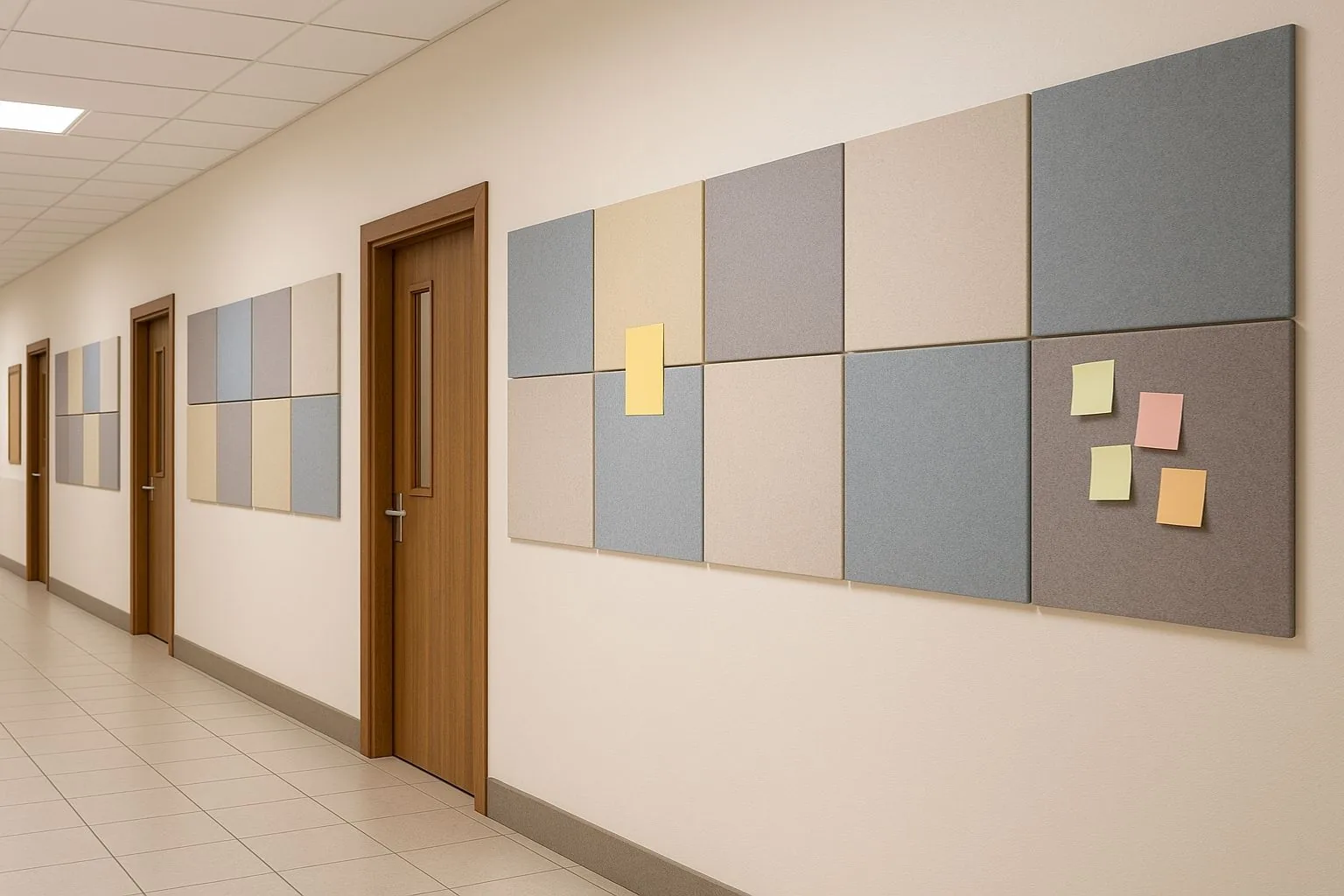
Halls and gyms
Dual use rooms carrying speech, music and sport, where durability decides the product. PET felt does not hold moisture or feed mould, which decides whether a ceiling survives more than a couple of seasons.
- Wood wool acoustic panels, 400 kg per cubic metre
- Ceiling baffles and clouds, Both faces work, which is why suspended area outperforms the same area laid flat
- Acoustic carpet and rugs, 64 sq ft per pack
For a Cambodia interior where the finish leads, we will say plainly what each option costs you acoustically. See how we work with interior designers.
04 / Climate
Why the climate in Cambodia changes the material, not the target
Cambodia is warm and humid through most of the year, with a long wet season, and that narrows the material list before acoustics is discussed.
Humidity is the deciding factor. PET felt does not absorb moisture, shed fibre or feed mould, which is why it outlasts fabric-wrapped mineral wool in this climate. Wood wool and timber need a ventilated cavity behind them.
The failure we design against here is mould, sagging fabric finishes and swelling in timber.
Consultants get the raw data, not a sales sheet. That is the whole of our side of the job, and it is set out under working with acoustic consultants.
06 / Read this first
What we watch go wrong on jobs like this
-
Panels at child height where they get damaged
It sounds like a small detail until the room is finished and the complaint arrives.
-
Treating one classroom and leaving the corridor
This is the one that comes back as a second fit-out rather than a snag.
-
Choosing a product that cannot take a football
Enclose the machine, break the vibration path, then deal with what is left. Doing it in the other order costs more and achieves less.
-
Treating it as a generic Cambodia job
Standby generation runs often enough to be a permanent condition and sits close to occupied space. Enclosure at the source is the only real fix.
05 / Logistics
Supply into Cambodia, start to site
| Ships from | Palwal, Haryana, India |
|---|---|
| Arrives at | Sihanoukville, then road to site |
| Dispatch | 4 to 7 working days |
| Freight | Sea via Sihanoukville |
| Support | Drawings, build-ups, BOQ and material that arrives complete |
Standard items dispatch in 4 to 7 working days. Grooved panels and custom colours take longer, and we say so before you order, not after.
Sea freight into Sihanoukville, then road to site. Air freight for samples and urgent quantities.
Questions from Cambodia projects
What makes school and classroom acoustics different in Cambodia?
Classrooms are hard and naturally ventilated, open to street and corridor noise. Standby generation runs often enough to be a permanent condition and sits close to occupied space. Enclosure at the source is the only real fix.
Where should the budget go first on a Cambodia project?
Classroom RT. A number, set against room volume, achieved mostly at the ceiling. Corridor spill. Long hard circulation feeds every room off it. Treating the corridor helps every classroom at once.
Do you have an office or installation team in Cambodia?
No. We manufacture in India and supply into Cambodia. We give you drawings, build-ups, a BOQ and material that arrives complete, and we will tell you plainly when a job needs a local contractor we cannot be.
How does material get to a Cambodia site?
ships from: Palwal, Haryana, India, arrives at: Sihanoukville, then road to site, dispatch: 4 to 7 working days. Standard items dispatch in 4 to 7 working days. Grooved panels and custom colours take longer, and we say so before you order, not after.
What goes wrong most often on this kind of project?
Panels at child height where they get damaged. Treating one classroom and leaving the corridor.
What do you need from us to quote?
A plan, a section through the critical partition or ceiling, and what the room is for. From that we can give a build-up and a BOQ rather than a price per square foot.
Next step
Drawings in, BOQ and a delivered date out
One drawing gets you a proper answer. Build-up, quantities, a delivered date, and an honest note on anything we think is the wrong approach.