

For projects in Cambodia
Auditorium acoustics and soundproofing in Cambodia
A large hard volume where speech falls apart long before anyone calls the room echoey. The target is intelligibility at the back row, which is a reverberation and early reflection problem, not a loudspeaker problem. Temples, function halls and conference rooms are hard volumes carrying amplified speech.
- Reverberation time
- Set against use. Speech and music want different numbers, and a dual use hall needs a decision.
- Early reflections
- Shaped surfaces that send energy to the rear seats rather than absorbing everything.
- Rear wall
- The single worst surface in most halls, and the first one to treat.
- Quote
- From a plan and a section, within 48 hours
01 / The material
What you are buying, and what it fixes in Cambodia
A large hard volume where speech falls apart long before anyone calls the room echoey. The target is intelligibility at the back row, which is a reverberation and early reflection problem, not a loudspeaker problem.
Temples, function halls and conference rooms are hard volumes carrying amplified speech.
Work reaching us from Cambodia is mostly garment and manufacturing units, hotels, offices, schools, hospitals, restaurants.
- Generators are part of the building Standby generation runs often enough to be a permanent condition and sits close to occupied space. Enclosure at the source is the only real fix.
- Garment floors at scale Large production halls with continuous machine noise and rooms where instructions and alarms must be understood.
- Tropical humidity PET felt does not hold moisture or feed mould, which decides whether a ceiling survives more than a couple of seasons.
- Reverberation time Set against use. Speech and music want different numbers, and a dual use hall needs a decision.
Full specification
Thickness, density, NRC by frequency, fire class, standard sizes and build-up detail for auditorium acoustics are on the main product page. This page covers what that means for a project in Cambodia.
02 / The build-up
The stack, in the order it is installed
-

Layer 1
Wood wool acoustic panels
Wood fibre bound into a rigid board with an open texture. In Cambodia, split units with condensers on facades and in narrow gaps between buildings.
With a porous backing. Board over mineral backing where the room needs more than the board alone gives.
-

Layer 2
Wooden slat acoustic panels
Timber slats on an acoustic backing. In Cambodia, temples, function halls and conference rooms are hard volumes carrying amplified speech.
Slats on felt backing. The standard. Absorption comes from the backing behind the gaps, so the slat gap ratio is an acoustic decision, not only a visual one.
-

Layer 3
Ceiling baffles and clouds
PET felt suspended from the soffit, vertically as baffles or horizontally as clouds. In Cambodia, classrooms are hard and naturally ventilated, open to street and corridor noise.
Mixed with services. Set out around ducts, trays and lighting rather than fighting them, coordinated from your reflected ceiling plan.
Architects working in Cambodia usually need the build-up before the product. We will draw the section and mark what does the work. See how we support architects.
03 / On the ground
What decides the build-up in Cambodia
- Generators are part of the building
Standby generation runs often enough to be a permanent condition and sits close to occupied space. Enclosure at the source is the only real fix.
- Garment floors at scale
Large production halls with continuous machine noise and rooms where instructions and alarms must be understood.
- Tropical humidity
PET felt does not hold moisture or feed mould, which decides whether a ceiling survives more than a couple of seasons.
- Hospitality in heritage towns
Hotel work where guest room isolation and function room acoustics are the recurring briefs.
- Assembly and performance rooms
Temples, function halls and conference rooms are hard volumes carrying amplified speech.
- School and campus buildings
Classrooms are hard and naturally ventilated, open to street and corridor noise.
04 / Room by room
Where the money goes on a Cambodia project
-
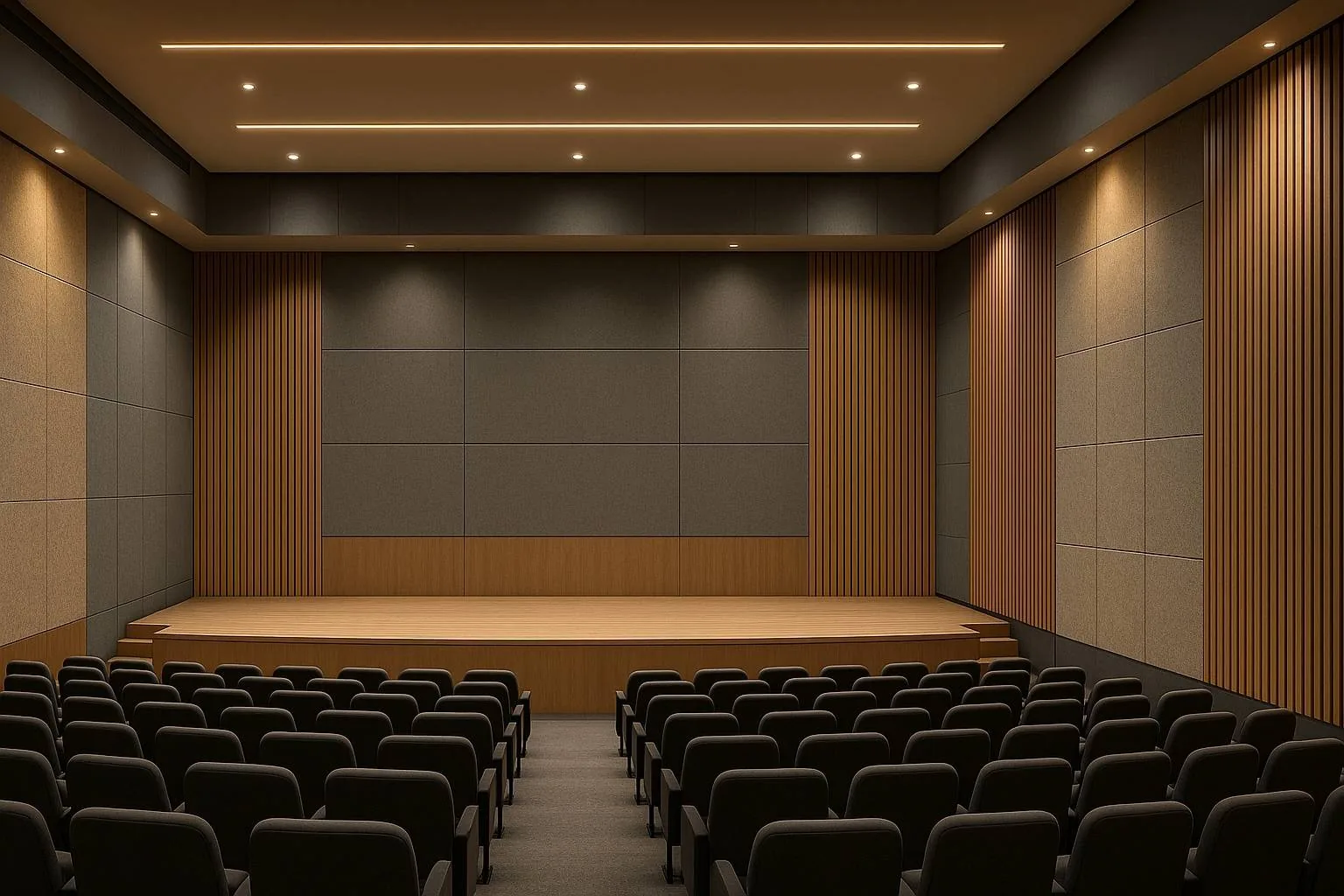
Reverberation time
Set against use. Speech and music want different numbers, and a dual use hall needs a decision. Standby generation runs often enough to be a permanent condition and sits close to occupied space. Enclosure at the source is the only real fix.
- Wooden slat acoustic panels, MDF, FR MDF, HDF or HDHMR
- Ceiling baffles and clouds, 9 to 24 mm
- Acoustic carpet and rugs, High density polyester
-
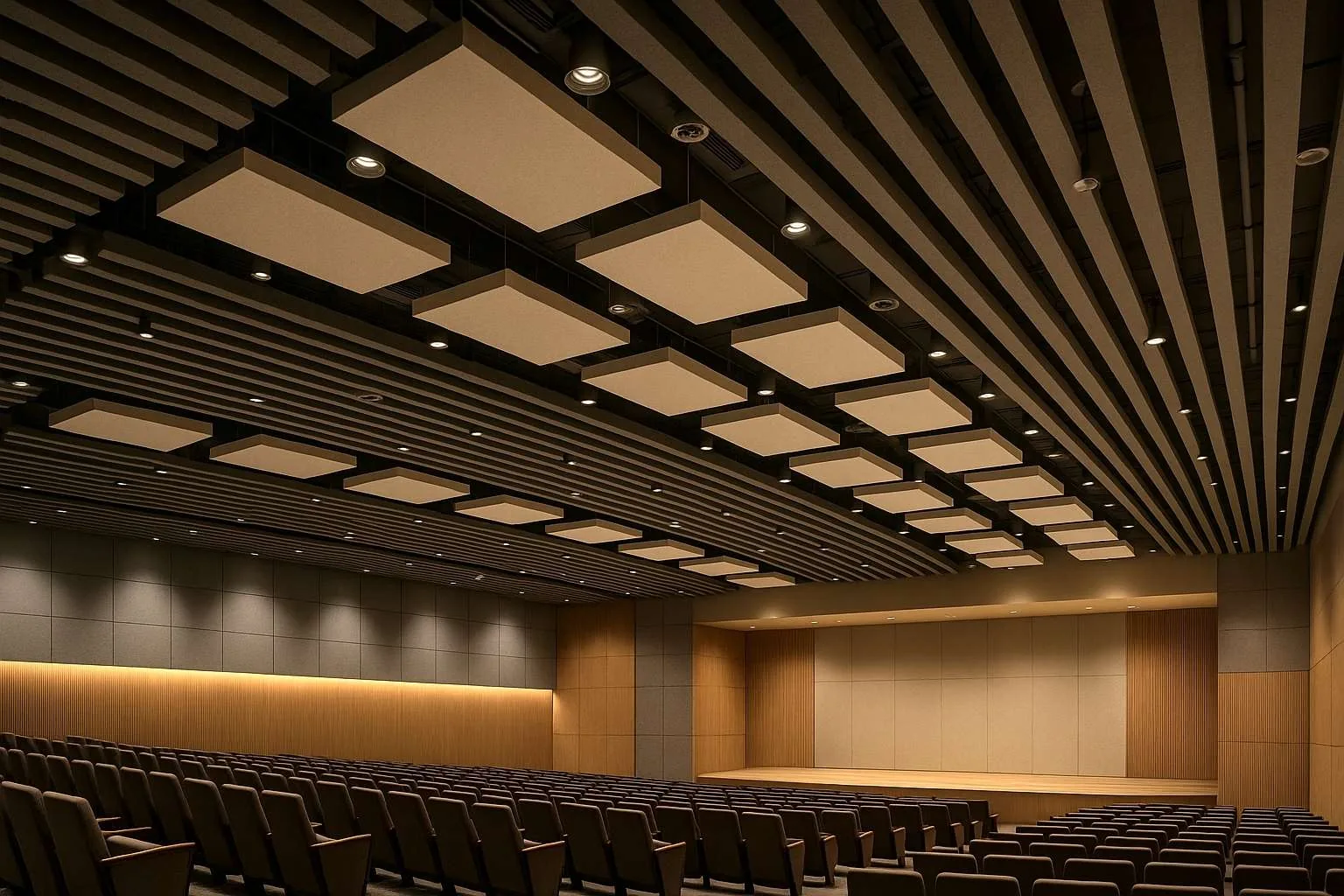
Early reflections
Shaped surfaces that send energy to the rear seats rather than absorbing everything. Large production halls with continuous machine noise and rooms where instructions and alarms must be understood.
- Wooden slat acoustic panels, 13-3, 14-2, 28-4 and 59-5
- Ceiling baffles and clouds, Made to the drawing, standard and custom
- Acoustic carpet and rugs, Felt
-
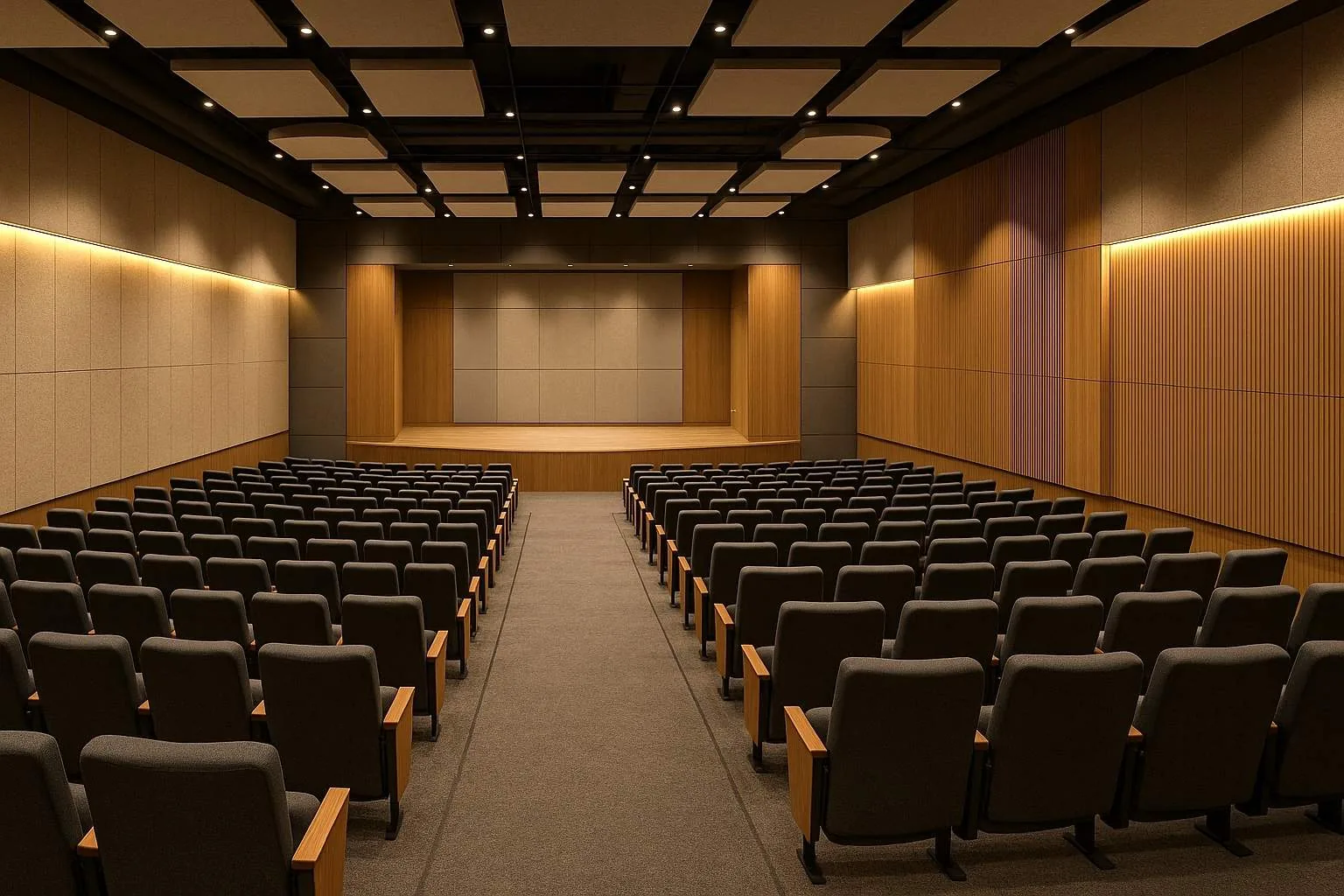
Rear wall
The single worst surface in most halls, and the first one to treat. PET felt does not hold moisture or feed mould, which decides whether a ceiling survives more than a couple of seasons.
- Wooden slat acoustic panels, 2440 x 192 mm and 2440 x 128 mm
- Ceiling baffles and clouds, Both faces work, which is why suspended area outperforms the same area laid flat
- Acoustic carpet and rugs, 64 sq ft per pack
Interior designers tend to arrive with the look already decided. We will tell you which finish gets there without losing the acoustics. See how we work with interior designers.
04 / Durability
What the Cambodia climate rules in and rules out
Cambodia is warm and humid through most of the year, with a long wet season, and that narrows the material list before acoustics is discussed.
Humidity is the deciding factor. PET felt does not absorb moisture, shed fibre or feed mould, which is why it outlasts fabric-wrapped mineral wool in this climate. Wood wool and timber need a ventilated cavity behind them.
The failure we design against here is mould, sagging fabric finishes and swelling in timber.
Consultants get the raw data, not a sales sheet. That is the whole of our side of the job, and it is set out under working with acoustic consultants.
06 / Worth knowing
Where this kind of project usually fails
-
Absorbing the whole room and losing the back rows
It sounds like a small detail until the room is finished and the complaint arrives.
-
Adding speakers to fix a reverberation problem
It sounds like a small detail until the room is finished and the complaint arrives.
-
Ignoring the rear wall because it is behind the audience
It sounds like a small detail until the room is finished and the complaint arrives.
-
Treating it as a generic Cambodia job
Standby generation runs often enough to be a permanent condition and sits close to occupied space. Enclosure at the source is the only real fix.
05 / Getting it there
Supply into Cambodia, start to site
| Ships from | Palwal, Haryana, India |
|---|---|
| Arrives at | Sihanoukville, then road to site |
| Dispatch | 4 to 7 working days |
| Freight | Sea via Sihanoukville |
| Support | Drawings, build-ups, BOQ and material that arrives complete |
Standard items dispatch in 4 to 7 working days. Grooved panels and custom colours take longer, and we say so before you order, not after.
Sea freight into Sihanoukville, then road to site. Air freight for samples and urgent quantities.
Questions from Cambodia projects
What makes auditorium acoustics and soundproofing different in Cambodia?
Temples, function halls and conference rooms are hard volumes carrying amplified speech. Standby generation runs often enough to be a permanent condition and sits close to occupied space. Enclosure at the source is the only real fix.
Where should the budget go first on a Cambodia project?
Reverberation time. Set against use. Speech and music want different numbers, and a dual use hall needs a decision. Early reflections. Shaped surfaces that send energy to the rear seats rather than absorbing everything.
Do you have an office or installation team in Cambodia?
No. We manufacture in India and supply into Cambodia. We give you drawings, build-ups, a BOQ and material that arrives complete, and we will tell you plainly when a job needs a local contractor we cannot be.
How does material get to a Cambodia site?
ships from: Palwal, Haryana, India, arrives at: Sihanoukville, then road to site, dispatch: 4 to 7 working days. Standard items dispatch in 4 to 7 working days. Grooved panels and custom colours take longer, and we say so before you order, not after.
What goes wrong most often on this kind of project?
Absorbing the whole room and losing the back rows. Adding speakers to fix a reverberation problem.
What do you need from us to quote?
A plan, a section through the critical partition or ceiling, and what the room is for. From that we can give a build-up and a BOQ rather than a price per square foot.
Next step
Drawings in, BOQ and a delivered date out
We quote from drawings, not from a square foot rate. Send a plan and the section through the critical wall or ceiling and you will get something you can actually build from.