

For projects in Mumbai
Cinema and multiplex soundproofing in Mumbai
Screens stacked beside and above each other, each running full range at high level. Bleed between auditoria is the failure everyone hears, and it is decided by the shell, not the finishes. Auditoriums, banquet halls and places of worship are large hard volumes in concrete and stone where speech falls apart long before anyone calls the room echoey.
- Screen to screen
- Independent construction between auditoria, with services broken at the line.
- In room response
- Heavy absorption on side and rear walls so the mix is heard as intended.
- Plant and projection
- Equipment noise into the auditorium, treated at source.
- Quote
- From a plan and a section, within 48 hours
01 / Start here
What you are buying, and what it fixes in Mumbai
Screens stacked beside and above each other, each running full range at high level. Bleed between auditoria is the failure everyone hears, and it is decided by the shell, not the finishes.
Auditoriums, banquet halls and places of worship are large hard volumes in concrete and stone where speech falls apart long before anyone calls the room echoey.
Work reaching us from Mumbai is mostly recording studios, offices, flats and redevelopment towers, restaurants, clinics, schools.
- Every centimetre is paid for At Mumbai rates a wall that grows a hundred millimetres into the room costs real money. A dense membrane with a resilient break usually beats a thick framed build-up here.
- The studio capital More recording and dubbing rooms per square kilometre than anywhere else we supply. They sit inside occupied buildings, so isolation comes before tuning, always.
- Monsoon damp defeats the wrong material PET felt does not absorb moisture, shed fibre or feed mould. Mineral products sag here within a couple of seasons.
- Screen to screen Independent construction between auditoria, with services broken at the line.
Full specification
Thickness, density, NRC by frequency, fire class, standard sizes and build-up detail for cinema soundproofing are on the main product page. This page covers what that means for a project in Mumbai.
02 / The build-up
What goes where, from the structure in
-

Layer 1
SoundBlanket mass loaded vinyl
A limp, high density sheet that adds mass to a partition, floor or duct without adding depth. In Mumbai, split units, VRF outdoor banks and diesel generator sets sit close to occupied areas, often on the same terrace as a bedroom. Generator enclosure and condenser screening are the recurring jobs.
Floor, floating. Membrane under a resilient layer and a floating deck, so impact energy is broken before it reaches the slab.
-

Layer 2
Acoustic panels
The full absorber range rather than one product: plain PET felt, printed felt, grooved panels and fabric finishes, chosen by how the room is used and how it has to look. In Mumbai, auditoriums, banquet halls and places of worship are large hard volumes in concrete and stone where speech falls apart long before anyone calls the room echoey.
Mixed finish. Plain felt where it is out of eye line, printed or grooved where it is seen.
-

Layer 3
PET felt acoustic panels
A rigid non-woven panel pressed from 100% polyester fibre, a large part of it recycled. In Mumbai, schools range from compact municipal buildings to large private campuses, all hard surfaced, with assembly halls doing duty as performance spaces.
Direct to wall. Panel bonded or mechanically fixed flat to the substrate. Simplest, and the weakest at low frequency.
Architects working in Mumbai usually need the build-up before the product. We will draw the section and mark what does the work. See how we support architects.
03 / In this market
What decides the build-up in Mumbai
- Every centimetre is paid for
At Mumbai rates a wall that grows a hundred millimetres into the room costs real money. A dense membrane with a resilient break usually beats a thick framed build-up here.
- The studio capital
More recording and dubbing rooms per square kilometre than anywhere else we supply. They sit inside occupied buildings, so isolation comes before tuning, always.
- Monsoon damp defeats the wrong material
PET felt does not absorb moisture, shed fibre or feed mould. Mineral products sag here within a couple of seasons.
- Redevelopment, built fast
Old buildings replaced by towers on tight programmes. Acoustic detail is easy to lose unless it is specified before the slab is poured.
- Assembly and performance rooms
Auditoriums, banquet halls and places of worship are large hard volumes in concrete and stone where speech falls apart long before anyone calls the room echoey.
04 / Room by room
What each space in a Mumbai project needs
-
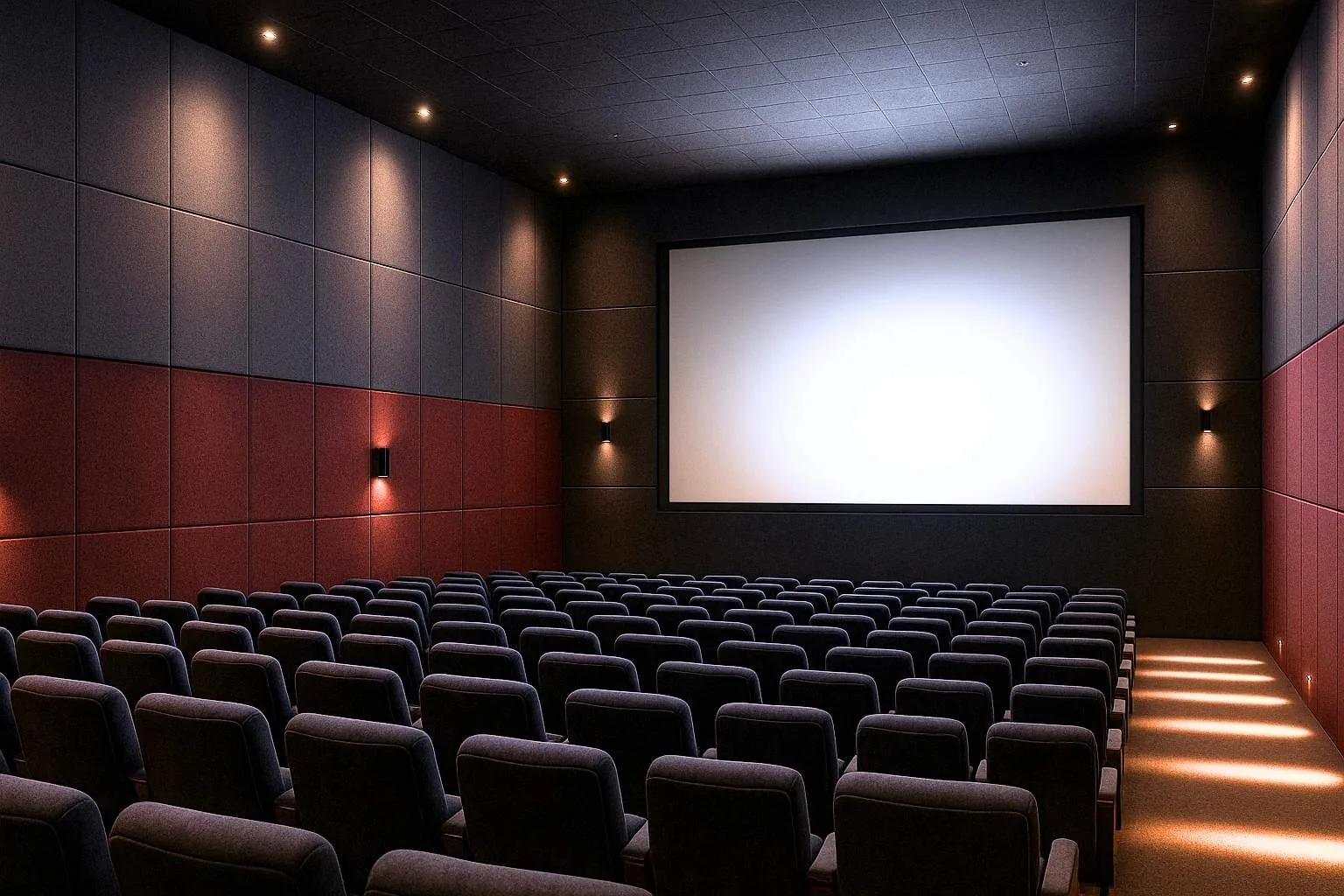
Screen to screen
Independent construction between auditoria, with services broken at the line. At Mumbai rates a wall that grows a hundred millimetres into the room costs real money. A dense membrane with a resilient break usually beats a thick framed build-up here.
- Soundproofing materials, 2100 kg per cubic metre. 2.5 mm STC 30 at 5.25 kg per sq m, 4 mm STC 34 at 8.4, 6 mm at 12.6
- Acoustic panels, 1800 x 900 mm, image printed into the felt rather than onto a facing
- PET felt acoustic panels, 4 to 24 mm
-
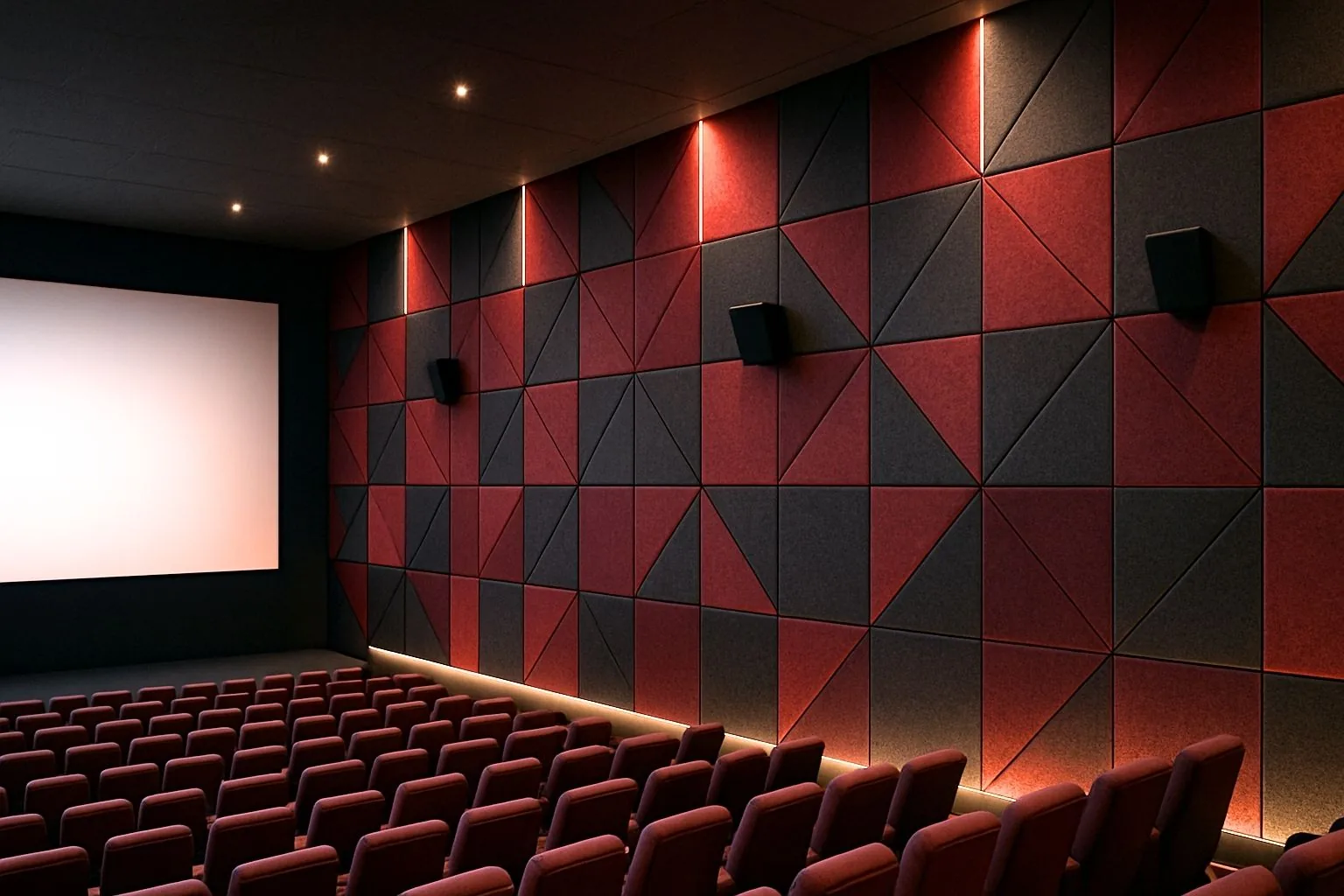
In room response
Heavy absorption on side and rear walls so the mix is heard as intended. More recording and dubbing rooms per square kilometre than anywhere else we supply. They sit inside occupied buildings, so isolation comes before tuning, always.
- Soundproofing materials, 1800 x 900 x 20 mm, 100 kg per cubic metre, NRC 0.85
- Acoustic panels, Cut pattern in PET felt, adds visual rhythm without changing the absorber
- PET felt acoustic panels, 1220 x 2440 mm standard, 4 x 8 ft
-
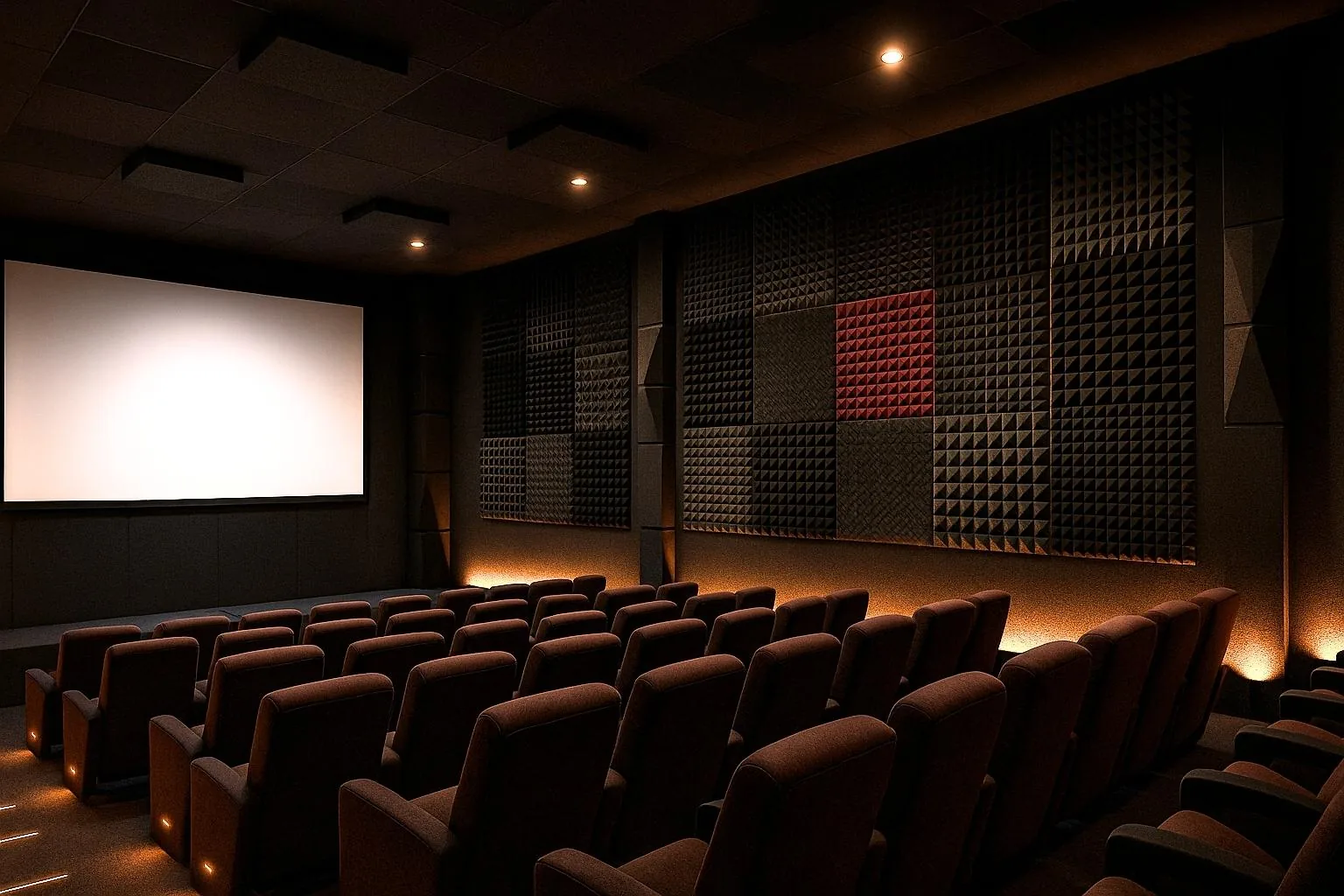
Plant and projection
Equipment noise into the auditorium, treated at source. PET felt does not absorb moisture, shed fibre or feed mould. Mineral products sag here within a couple of seasons.
- Soundproofing materials, Mass, then decoupling, then cavity absorption, then sealing
- Acoustic panels, ASTM C423
- PET felt acoustic panels, 2440 x 4270 mm, 2.44 x 4.27 m, 8 x 14 ft
For a Mumbai interior where the finish leads, we will say plainly what each option costs you acoustically. See how we work with interior designers.
04 / Conditions
What the Mumbai climate rules in and rules out
Mumbai is warm and humid through most of the year, with a long wet season, and that narrows the material list before acoustics is discussed.
Humidity is the deciding factor. PET felt does not absorb moisture, shed fibre or feed mould, which is why it outlasts fabric-wrapped mineral wool in this climate. Wood wool and timber need a ventilated cavity behind them.
The failure we design against here is mould, sagging fabric finishes and swelling in timber.
On a Mumbai job with a consultant involved, our part is material that matches the submitted data. See working with acoustic consultants.
06 / Worth knowing
Where this kind of project usually fails
-
A shared service void running across the wall line
Square metre for square metre the ceiling is the cheapest result in the room. Skipping it and buying wall panels instead is the most common way to overspend.
-
Treating the auditorium to fix bleed from the next screen
Small on the drawing, expensive on site, and almost always found after handover.
-
Doors and lobbies specified late and undersized
A gap undoes the partition it sits in. Sealing is the cheapest line on the quote and the first one to get cut.
-
Treating it as a generic Mumbai job
At Mumbai rates a wall that grows a hundred millimetres into the room costs real money. A dense membrane with a resilient break usually beats a thick framed build-up here.
05 / Route to site
Getting it to Mumbai, with real dates
| Made at | Our own plant, Palwal, Haryana |
|---|---|
| Reaches site in | three to four days |
| Dispatch | 2 to 4 working days |
| To site | three to four days |
| Support | Drawings, build-ups, BOQ and material that arrives complete |
Standard items dispatch in 2 to 4 working days from our plant at Palwal. Grooved panels and custom colours take longer, and we say so before you order, not after.
By road from Palwal, roughly fourteen hundred kilometres, normally three to four days on a dedicated truck.
Questions from Mumbai projects
What makes cinema and multiplex soundproofing different in Mumbai?
Auditoriums, banquet halls and places of worship are large hard volumes in concrete and stone where speech falls apart long before anyone calls the room echoey. At Mumbai rates a wall that grows a hundred millimetres into the room costs real money. A dense membrane with a resilient break usually beats a thick framed build-up here.
Where should the budget go first on a Mumbai project?
Screen to screen. Independent construction between auditoria, with services broken at the line. In room response. Heavy absorption on side and rear walls so the mix is heard as intended.
Do you have an office or installation team in Mumbai?
No. We manufacture in India and supply into Mumbai. We give you drawings, build-ups, a BOQ and material that arrives complete, and we will tell you plainly when a job needs a local contractor we cannot be.
How does material get to a Mumbai site?
made at: Our own plant, Palwal, Haryana, reaches site in: three to four days, dispatch: 2 to 4 working days. Standard items dispatch in 2 to 4 working days from our plant at Palwal. Grooved panels and custom colours take longer, and we say so before you order, not after.
What goes wrong most often on this kind of project?
A shared service void running across the wall line. Treating the auditorium to fix bleed from the next screen.
What do you need from us to quote?
A plan, a section through the critical partition or ceiling, and what the room is for. From that we can give a build-up and a BOQ rather than a price per square foot.
Next step
Tell us the room, we will tell you the build-up
Send what you have. We will give you a layer by layer build-up, a bill of quantities and a date material lands, and we will flag anything in the brief that will not achieve what you want.