

For projects in Miami
Venue and restaurant acoustics in Miami
Two different jobs that get quoted as one: keeping bass inside the building for the neighbours, and making the room comfortable enough that guests can talk. Solving one does nothing for the other. Churches, school gyms and multipurpose halls double as performance spaces, which means a room designed for neither speech nor music has to carry both.
- Containment
- Low frequency through structure to flats above and beside. Mass, decoupling and a sealed envelope.
- Table level comfort
- Absorption at the ceiling so guests stop raising their voices at each other.
- Entrance and service
- Doors, lobbies and extract paths, which is where most of the leakage actually is.
- Quote
- From a plan and a section, within 48 hours
01 / The material
What you are buying, and what it fixes in Miami
Two different jobs that get quoted as one: keeping bass inside the building for the neighbours, and making the room comfortable enough that guests can talk. Solving one does nothing for the other.
Churches, school gyms and multipurpose halls double as performance spaces, which means a room designed for neither speech nor music has to carry both.
Work reaching us from Miami is mostly condo towers, hotels and lounges, restaurants, offices, clinics, home theatres.
- Concrete towers, hard interiors The structure has mass, so airborne transfer between units is usually not the issue. Reverberation inside glass, tile and terrazzo rooms is, and that is a treatment job.
- Impact noise through slabs Hard flooring over a concrete slab passes footfall straight down. A resilient underlay is the fix, and it has to go in before the finish, not after the complaint.
- Heat and humidity Our PET felt does not absorb moisture, shed fibre or feed mould, which matters in a climate where mineral products sag and hold damp.
- Containment Low frequency through structure to flats above and beside. Mass, decoupling and a sealed envelope.
Full specification
Thickness, density, NRC by frequency, fire class, standard sizes and build-up detail for venue soundproofing are on the main product page. This page covers what that means for a project in Miami.
Nightclub and venue soundproofing SoundBlanket mass loaded vinyl
02 / The build-up
The build-up, layer by layer
-

Layer 1
SoundBlanket mass loaded vinyl
A limp, high density sheet that adds mass to a partition, floor or duct without adding depth. In Miami, packaged rooftop units and ducted forced air are standard, so noise arrives through the duct rather than through the wall. Lining the first three metres of duct and treating the return path is usually the whole job.
Wall, decoupled. Independent stud, membrane between the boards, cavity absorption, two boards. The membrane is one part of a system, never the whole answer.
-

Layer 2
Acoustic panels
The full absorber range rather than one product: plain PET felt, printed felt, grooved panels and fabric finishes, chosen by how the room is used and how it has to look. In Miami, churches, school gyms and multipurpose halls double as performance spaces, which means a room designed for neither speech nor music has to carry both.
Mixed finish. Plain felt where it is out of eye line, printed or grooved where it is seen.
-

Layer 3
Acoustic carpet and rugs
A tile carpet with a dense polyester face on a felt backing. In Miami, public school buildings run long corridors with hard floors and lay-in tile ceilings that were chosen for cost, not for speech. Classroom reverberation and corridor spill are the two complaints, and both respond to ceiling area rather than wall panels.
Zoned. Carpet in the circulation and meeting zones, hard floor elsewhere, so the treatment sits where the noise is made.
We would rather argue about the build-up at design stage than on site. See how we support architects.
03 / On the ground
What the buildings in Miami do to the specification
- Concrete towers, hard interiors
The structure has mass, so airborne transfer between units is usually not the issue. Reverberation inside glass, tile and terrazzo rooms is, and that is a treatment job.
- Impact noise through slabs
Hard flooring over a concrete slab passes footfall straight down. A resilient underlay is the fix, and it has to go in before the finish, not after the complaint.
- Heat and humidity
Our PET felt does not absorb moisture, shed fibre or feed mould, which matters in a climate where mineral products sag and hold damp.
- The port is in the city
Containers land at PortMiami and reach site the same day, which is the practical reason a factory in India competes here on landed cost.
- Assembly and performance rooms
Churches, school gyms and multipurpose halls double as performance spaces, which means a room designed for neither speech nor music has to carry both.
04 / Room by room
What each space in a Miami project needs
-

Containment
Low frequency through structure to flats above and beside. Mass, decoupling and a sealed envelope. The structure has mass, so airborne transfer between units is usually not the issue. Reverberation inside glass, tile and terrazzo rooms is, and that is a treatment job.
- SoundBlanket mass loaded vinyl, 2100 kg per cubic metre
- Acoustic panels, 1800 x 900 mm, image printed into the felt rather than onto a facing
- Wooden slat acoustic panels, 2440 x 192 mm and 2440 x 128 mm
-
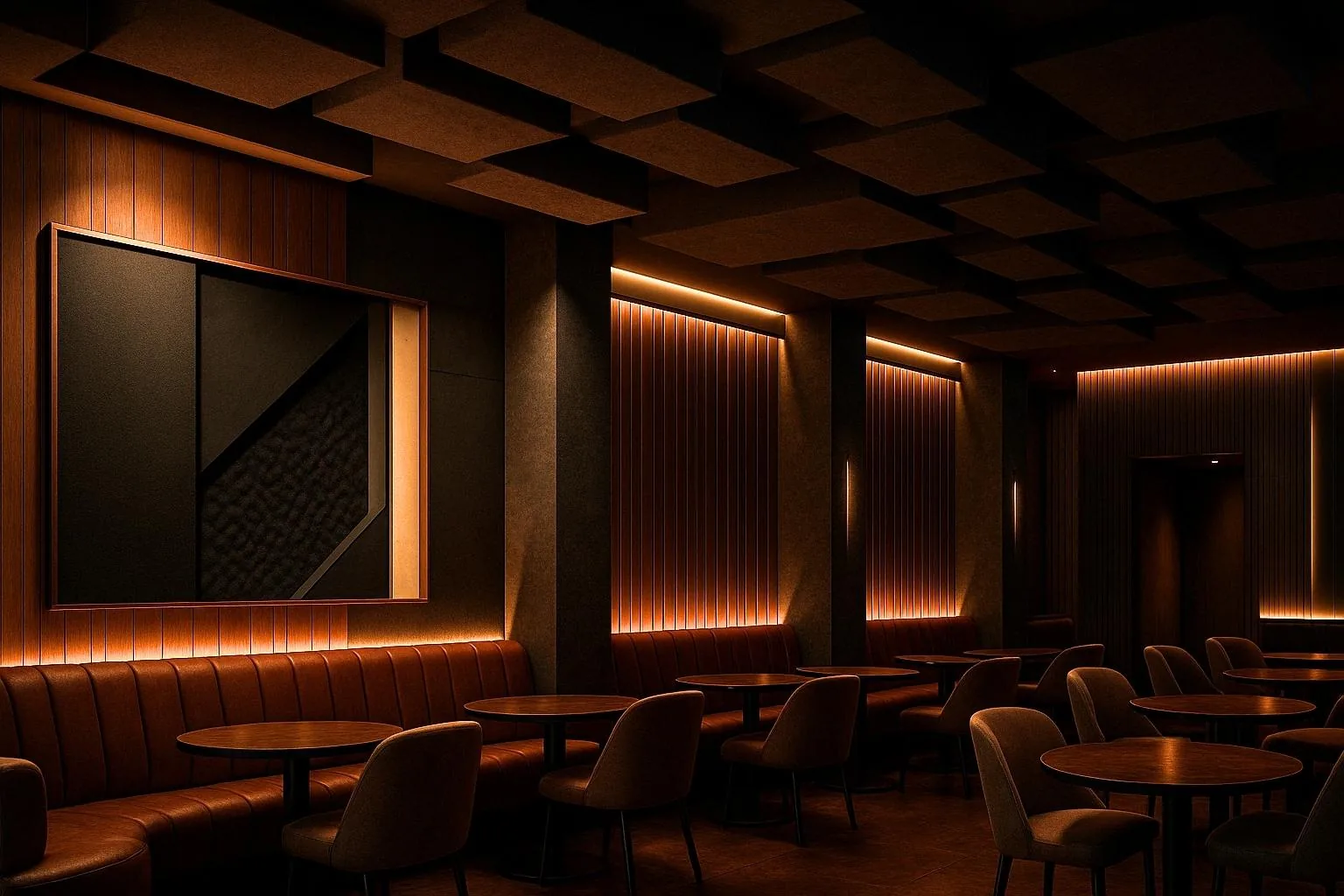
Table level comfort
Absorption at the ceiling so guests stop raising their voices at each other. Hard flooring over a concrete slab passes footfall straight down. A resilient underlay is the fix, and it has to go in before the finish, not after the complaint.
- SoundBlanket mass loaded vinyl, STC 30, 5.25 kg per sq m
- Acoustic panels, Cut pattern in PET felt, adds visual rhythm without changing the absorber
- Wooden slat acoustic panels, 14, 16 and 18 mm
-
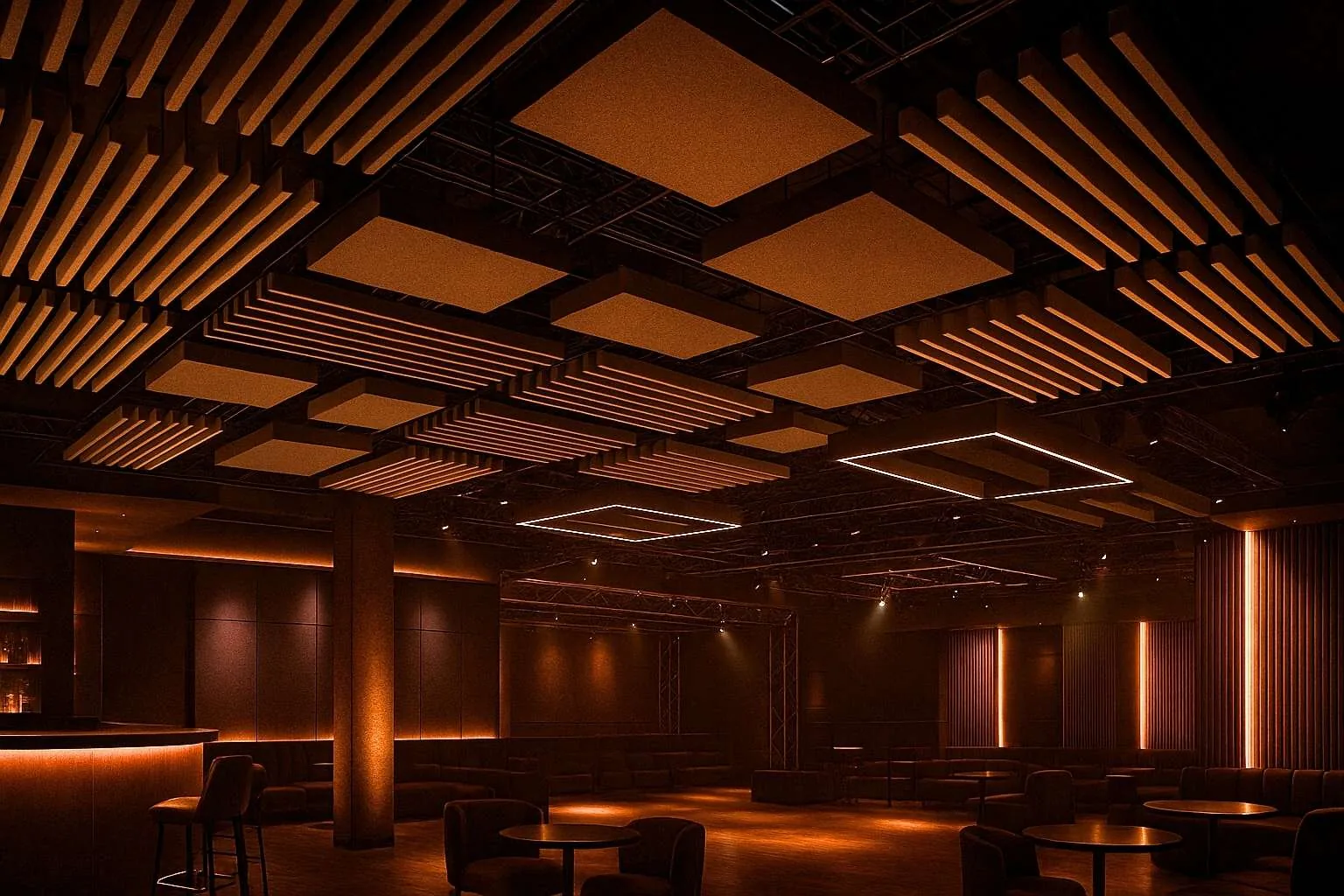
Entrance and service
Doors, lobbies and extract paths, which is where most of the leakage actually is. Our PET felt does not absorb moisture, shed fibre or feed mould, which matters in a climate where mineral products sag and hold damp.
- SoundBlanket mass loaded vinyl, STC 34, 8.4 kg per sq m
- Acoustic panels, ASTM C423
- Wooden slat acoustic panels, 96 sq ft per unit
Designers get colour, pattern and CNC options with the absorption figure attached to each. See how we work with interior designers.
04 / Climate
What the Miami climate rules in and rules out
Miami is hot dry summers and mild wet winters, and that narrows the material list before acoustics is discussed.
The swing between a dry summer and a wet winter moves timber. PET felt is dimensionally stable across that swing; slat panels want a stable substrate and a ventilated fixing.
The failure we design against here is seasonal movement in timber and winter damp in unheated stock.
On a Miami job with a consultant involved, our part is material that matches the submitted data. See working with acoustic consultants.
06 / Worth knowing
What we watch go wrong on jobs like this
-
Panels on the wall as a neighbour noise solution
Small on the drawing, expensive on site, and almost always found after handover.
-
A lobby with both doors able to open at once
Soundproofing fails at the gaps, not the materials. One unsealed service penetration can undo a correctly built wall.
-
Extract ducting that bypasses every wall you built
Enclose the machine, break the vibration path, then deal with what is left. Doing it in the other order costs more and achieves less.
-
Treating it as a generic Miami job
The structure has mass, so airborne transfer between units is usually not the issue. Reverberation inside glass, tile and terrazzo rooms is, and that is a treatment job.
05 / Supply
What the route into Miami actually looks like
| Ships from | Palwal, Haryana, India |
|---|---|
| Arrives at | PortMiami, then a short road run to site |
| Dispatch | 4 to 7 working days |
| Freight | Sea into PortMiami |
| Support | Drawings, build-ups, BOQ and material that arrives complete |
Standard items dispatch in 4 to 7 working days. The sea leg from India is long, so plan the full door to door window into the programme. We give real dates, not optimistic ones.
Sea freight direct into PortMiami, then a short road run to site. Air freight for samples, approvals and urgent quantities.
Questions from Miami projects
What makes venue and restaurant acoustics different in Miami?
Churches, school gyms and multipurpose halls double as performance spaces, which means a room designed for neither speech nor music has to carry both. The structure has mass, so airborne transfer between units is usually not the issue. Reverberation inside glass, tile and terrazzo rooms is, and that is a treatment job.
Where should the budget go first on a Miami project?
Containment. Low frequency through structure to flats above and beside. Mass, decoupling and a sealed envelope. Table level comfort. Absorption at the ceiling so guests stop raising their voices at each other.
Do you have an office or installation team in Miami?
No. We manufacture in India and supply into Miami. We give you drawings, build-ups, a BOQ and material that arrives complete, and we will tell you plainly when a job needs a local contractor we cannot be.
How does material get to a Miami site?
ships from: Palwal, Haryana, India, arrives at: PortMiami, then a short road run to site, dispatch: 4 to 7 working days. Standard items dispatch in 4 to 7 working days. The sea leg from India is long, so plan the full door to door window into the programme. We give real dates, not optimistic ones.
What goes wrong most often on this kind of project?
Panels on the wall as a neighbour noise solution. A lobby with both doors able to open at once.
What do you need from us to quote?
A plan, a section through the critical partition or ceiling, and what the room is for. From that we can give a build-up and a BOQ rather than a price per square foot.
Next step
Send the drawings, get a straight answer
Send what you have. We will give you a layer by layer build-up, a bill of quantities and a date material lands, and we will flag anything in the brief that will not achieve what you want.