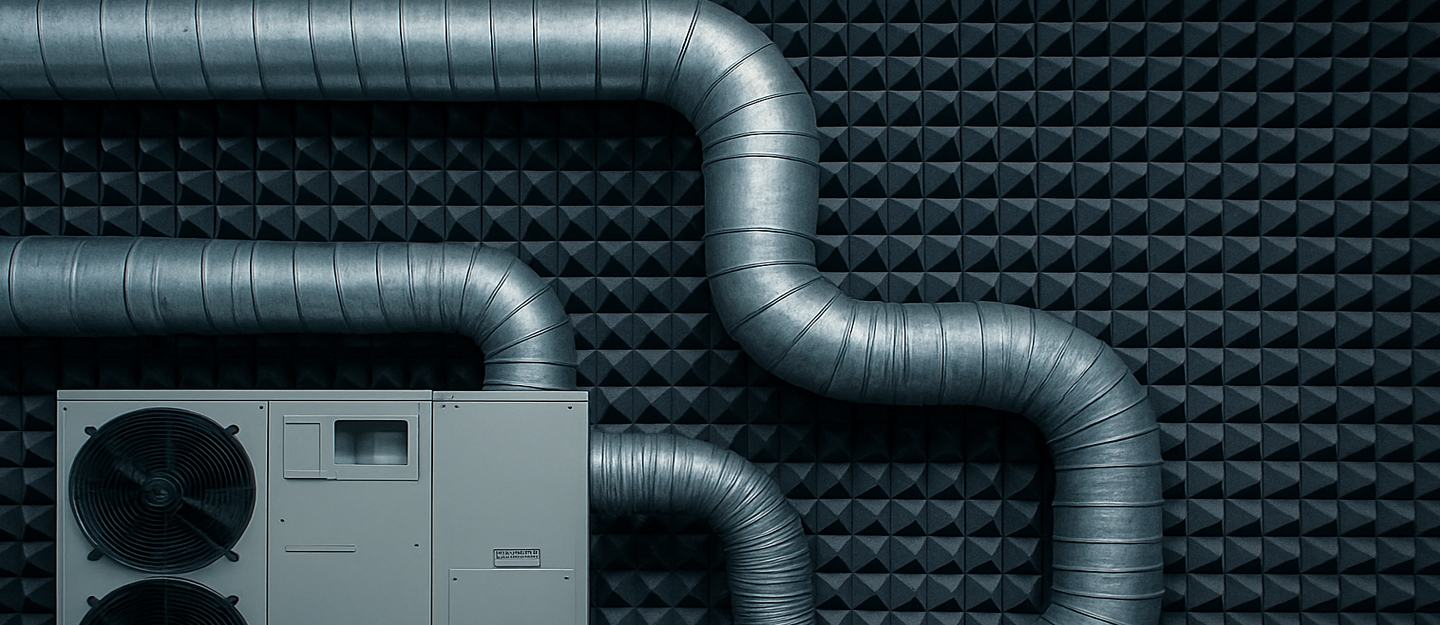
For projects in Toronto
HVAC, plant and machine noise control in Toronto
Noise with a source. Almost every honest fix is at the machine, the duct or the plant room, and almost nothing useful happens by lining the far wall of the occupied space. Forced air heating runs most of the year, so duct-borne noise and return air paths carry sound between rooms as reliably as the walls do.
- At source
- Enclosure, barrier or anti vibration mounts at the machine.
- In the path
- Duct lining, attenuators and lagging on the first run out of the plant.
- At the receiver
- Only after the first two, and only for what is left.
- Quote
- From a plan and a section, within 48 hours
01 / What it is
The product, described honestly, for a Toronto brief
Noise with a source. Almost every honest fix is at the machine, the duct or the plant room, and almost nothing useful happens by lining the far wall of the occupied space.
Forced air heating runs most of the year, so duct-borne noise and return air paths carry sound between rooms as reliably as the walls do.
Work reaching us from Toronto is mostly condominium towers, offices, studios, restaurants, schools, clinics.
- Condo detail repeated at scale The same party wall and floor assembly across thousands of units. If it underperforms it underperforms everywhere, so it is worth solving on the drawing.
- Concrete towers, hard interiors The frame carries mass, so the recurring complaints are impact through slabs and rooms that are simply too live.
- Sealed against deep winters Buildings close up for months with mechanical systems working hard, so noise accumulates inside.
- At source Enclosure, barrier or anti vibration mounts at the machine.
Full specification
Thickness, density, NRC by frequency, fire class, standard sizes and build-up detail for HVAC and plant noise control are on the main product page. This page covers what that means for a project in Toronto.
02 / The build-up
The build-up, layer by layer
-

Layer 1
Soundproofing materials
The blocking side of the range taken together: mass loaded vinyl, resilient layers, cavity absorption and the build-ups they belong in. In Toronto, forced air heating runs most of the year, so duct-borne noise and return air paths carry sound between rooms as reliably as the walls do.
Resilient bar. Where a full independent leaf will not fit. Effective, and very easy to short circuit with one wrong screw.
-

Layer 2
Acoustic foam and BassBloc
Open cell foam shapes for high frequency control, and BassBloc, a high density absorber built for the low mid range where ordinary foam does nothing. In Toronto, community centres, school gymnasiums and church halls carry speech, music and sport in the same hard volume.
Behind a fabric frame. Where the room has to look finished, absorber inside a frame rather than foam on show.
-

Layer 3
Ceiling baffles and clouds
PET felt suspended from the soffit, vertically as baffles or horizontally as clouds. In Toronto, school buildings run hard floors and lay-in tile with long heating seasons and sealed envelopes, so rooms stay live and mechanical noise is always present.
Vertical baffles. Hung on edge in rows. Both faces absorb, so coverage figures based on plan area understate them.
For a Toronto practice, the useful thing is a detail you can put in a drawing set, not a brochure. See how we support architects.
03 / Local conditions
The Toronto conditions that change the answer
- Condo detail repeated at scale
The same party wall and floor assembly across thousands of units. If it underperforms it underperforms everywhere, so it is worth solving on the drawing.
- Concrete towers, hard interiors
The frame carries mass, so the recurring complaints are impact through slabs and rooms that are simply too live.
- Sealed against deep winters
Buildings close up for months with mechanical systems working hard, so noise accumulates inside.
- Plan the leg from Montreal
The container lands on the St Lawrence and drives in. We quote the sea leg and the road leg separately.
- Plant and HVAC
Forced air heating runs most of the year, so duct-borne noise and return air paths carry sound between rooms as reliably as the walls do.
04 / Room by room
What each space in a Toronto project needs
-
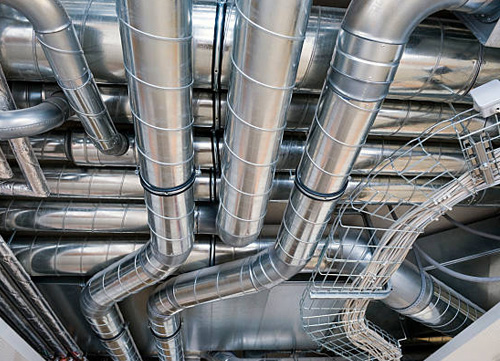
At source
Enclosure, barrier or anti vibration mounts at the machine. The same party wall and floor assembly across thousands of units. If it underperforms it underperforms everywhere, so it is worth solving on the drawing.
- Soundproofing materials, 2100 kg per cubic metre. 2.5 mm STC 30 at 5.25 kg per sq m, 4 mm STC 34 at 8.4, 6 mm at 12.6
- Wood wool acoustic panels, 20 mm
- Acoustic foam and BassBloc, 100 kg per cubic metre
-
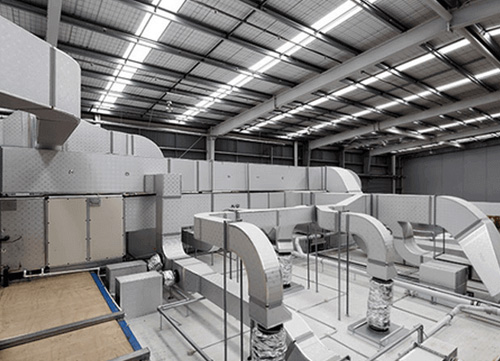
In the path
Duct lining, attenuators and lagging on the first run out of the plant. The frame carries mass, so the recurring complaints are impact through slabs and rooms that are simply too live.
- Soundproofing materials, 1800 x 900 x 20 mm, 100 kg per cubic metre, NRC 0.85
- Wood wool acoustic panels, 400 kg per cubic metre
- Acoustic foam and BassBloc, 100 to 500 Hz
-
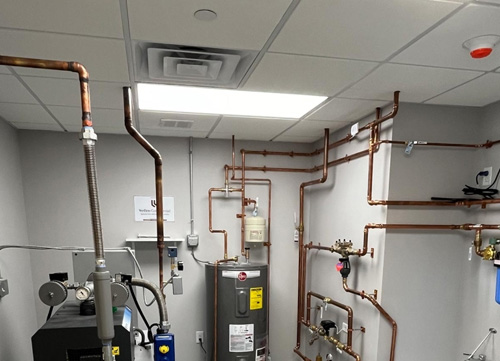
At the receiver
Only after the first two, and only for what is left. Buildings close up for months with mechanical systems working hard, so noise accumulates inside.
- Soundproofing materials, Mass, then decoupling, then cavity absorption, then sealing
- Wood wool acoustic panels, 0.30
- Acoustic foam and BassBloc, 0.85
Designers get colour, pattern and CNC options with the absorption figure attached to each. See how we work with interior designers.
04 / Durability
What the Toronto climate rules in and rules out
Toronto is cool and damp, with long heating seasons and cold external walls, and that narrows the material list before acoustics is discussed.
Cold wall build-ups and long heating seasons mean interstitial condensation is a real risk behind any lining. PET felt is unaffected by damp air and will not feed mould where a fabric-faced mineral product would.
The failure we design against here is condensation behind linings in older, poorly insulated stock.
If a consultant has set the target, we will quote against their figures rather than ours, and stay out of the scope they own. More on working with acoustic consultants.
06 / Read this first
What we watch go wrong on jobs like this
-
Absorption on the office wall for a plant room problem
Noise with a source is fixed at the source. Treating the receiving room is the expensive way to get a small result.
-
Lagging a duct that is carrying the noise as breakout from the fan
Noise with a source is fixed at the source. Treating the receiving room is the expensive way to get a small result.
-
Ignoring structure borne vibration through the mounts
This is the one that comes back as a second fit-out rather than a snag.
-
Treating it as a generic Toronto job
The same party wall and floor assembly across thousands of units. If it underperforms it underperforms everywhere, so it is worth solving on the drawing.
05 / Logistics
Getting it to Toronto, with real dates
| Ships from | Palwal, Haryana, India |
|---|---|
| Arrives at | Montreal, then road to Toronto |
| Dispatch | 4 to 7 working days |
| Freight | Sea via Montreal, then road |
| Support | Drawings, build-ups, BOQ and material that arrives complete |
Standard items dispatch in 4 to 7 working days. The sea leg from India is long, so plan the full door to door window into the programme. We give real dates, not optimistic ones.
Sea freight into Montreal, then road to Toronto. Air freight for samples and urgent quantities.
Questions from Toronto projects
What makes HVAC, plant and machine noise control different in Toronto?
Forced air heating runs most of the year, so duct-borne noise and return air paths carry sound between rooms as reliably as the walls do. The same party wall and floor assembly across thousands of units. If it underperforms it underperforms everywhere, so it is worth solving on the drawing.
Where should the budget go first on a Toronto project?
At source. Enclosure, barrier or anti vibration mounts at the machine. In the path. Duct lining, attenuators and lagging on the first run out of the plant.
Do you have an office or installation team in Toronto?
No. We manufacture in India and supply into Toronto. We give you drawings, build-ups, a BOQ and material that arrives complete, and we will tell you plainly when a job needs a local contractor we cannot be.
How does material get to a Toronto site?
ships from: Palwal, Haryana, India, arrives at: Montreal, then road to Toronto, dispatch: 4 to 7 working days. Standard items dispatch in 4 to 7 working days. The sea leg from India is long, so plan the full door to door window into the programme. We give real dates, not optimistic ones.
What goes wrong most often on this kind of project?
Absorption on the office wall for a plant room problem. Lagging a duct that is carrying the noise as breakout from the fan.
What do you need from us to quote?
A plan, a section through the critical partition or ceiling, and what the room is for. From that we can give a build-up and a BOQ rather than a price per square foot.
Next step
Send the drawings, get a straight answer
We quote from drawings, not from a square foot rate. Send a plan and the section through the critical wall or ceiling and you will get something you can actually build from.