Home > New Zealand > Soundproof curtains
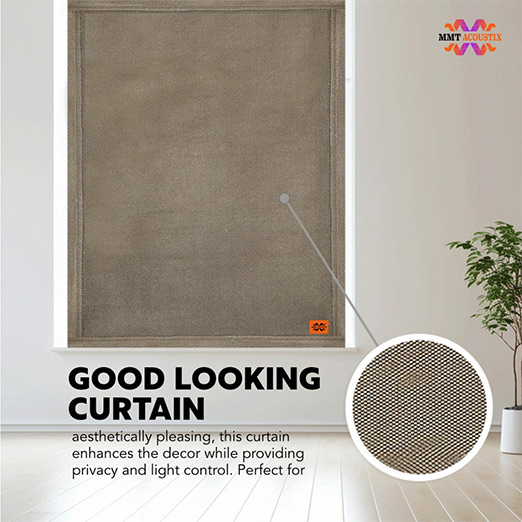
Manufactured in India, supplied in New Zealand
Soundproof curtains in New Zealand
We manufacture soundproof curtains at our own plant at Palwal in Haryana, India, and supply them into New Zealand. Made at our own plant in India and shipped into Auckland or Tauranga.
- Build-up
- 800 GSM face, foam, 3 mm SoundBlanket MLV core, foam, 800 GSM face
- Total thickness
- 10 to 12 mm
- Weight
- 5.5 kg per sq m
- Reduction
- Up to 30 dB
- STC
- 30
- Lead time
- Made to size
- Minimum order
- 5 pieces
- ASTM E90
- Standard sizes, 8 x 4 ft and 5 x 4 ft
- Made at our own plant, Palwal, Haryana, India
We make this ourselves and ship it to you. No local branch, no borrowed certifications, no dealer margin. One batch across the whole order, and an honest answer when the product is wrong for the problem.
01 / Start here
The material, and what it actually does on a New Zealand job
A layered curtain with a mass loaded vinyl core, used where an opening has to stay an opening. It is the answer for a doorway, a stage, a partition that must move, not a substitute for a wall.
Work reaching us from New Zealand is mostly timber frame housing, apartments, offices, schools, clinics, studios.
Timber frame with plasterboard linings, so walls have very little mass. Apartment and townhouse party walls need a second leaf rather than surface treatment.
- Full height with return Curtain taken floor to soffit with a side return and an overlap, because the gap is what leaks, not the fabric.
- Track with a seal Ceiling track plus a floor seal or drape, so the perimeter is closed when it is drawn.
- Double layer at a doorway Two curtains with an air gap where a single layer will not reach the target.
- What it will not do A curtain is only as good as its perimeter. Hung short, hung flat against a frame, or with a gap at the side, it will measure nothing like the figure on the sheet.
Full specification
Thickness, density, NRC by frequency, fire class, standard sizes and build-up detail for soundproof curtains are on the main product page. This page covers what that means for a project in New Zealand.
02 / Specification
The published figures, unchanged by location
These figures are published and they do not move. The thing worth arguing about is not the number on the sheet, it is which grade and which build-up suits the room you are treating.
- Standard5.5 kg per sq m. Openings, stages, temporary partitions
| Build-up | 800 GSM face, foam, 3 mm SoundBlanket MLV core, foam, 800 GSM face |
|---|---|
| Total thickness | 10 to 12 mm |
| Weight | 5.5 kg per sq m |
| Reduction | Up to 30 dB |
| STC | 30 |
| Test standard | ASTM E90 |
| Standard sizes | 8 x 4 ft and 5 x 4 ft |
On a New Zealand job with a consultant involved, our part is material that matches the submitted data. See working with acoustic consultants.
03 / In this market
What decides the build-up in New Zealand
- Damp and variable climate
PET felt does not absorb moisture, shed fibre or feed mould, which suits cold external walls and sealed rooms.
- Timber frame, very little mass
Light construction passes low frequency easily. Added mass and a decoupled layer do the work, and absorption alone will not.
- Designed to move
Seismic detailing means junctions and joints that have to stay flexible. An acoustic build-up has to respect that rather than bridge it rigidly.
- A long sea leg
This is one of the longest routes we run. Ordering to a real schedule matters more here than anywhere else, so we quote the full window.
- The housing stock
Timber frame with plasterboard linings, so walls have very little mass. Apartment and townhouse party walls need a second leaf rather than surface treatment.
- The studio and content scene
Project studios go into garages and sleepouts in timber framed housing that leaks at every junction.
Architects working in New Zealand usually need the build-up before the product. We will draw the section and mark what does the work. See how we support architects.
04 / Conditions
Durability in New Zealand, before acoustics is discussed
New Zealand is cool and damp, with long heating seasons and cold external walls, and that narrows the sensible material list before acoustics is even discussed.
Cold wall build-ups and long heating seasons mean interstitial condensation is a real risk behind any lining. PET felt is unaffected by damp air and will not feed mould where a fabric-faced mineral product would.
The risk we design against here is condensation behind linings in older, poorly insulated stock.
Designers get colour, pattern and CNC options with the absorption figure attached to each. See how we work with interior designers.
05 / Getting it there
Supply into New Zealand, start to site
| Ships from | Palwal, Haryana, India |
|---|---|
| Arrives at | Auckland or Tauranga, then road to site |
| Dispatch | 4 to 7 working days |
| Freight | Sea via Auckland |
| Packing | Rolled and bagged with track and fixings listed separately. |
| Lead time | Made to size. Confirmed at quote. |
Standard items dispatch in 4 to 7 working days. The sea leg from India is long, so plan the full door to door window into the programme. We give real dates, not optimistic ones.
Sea freight into Auckland or Tauranga, then road to site. Air freight for samples and genuinely urgent quantities.
The same 5 piece minimum applies on export.
| Any size | 5 pieces |
|---|
Curtains are made to size, so the minimum is counted in pieces rather than area.
06 / Read this first
Where this goes wrong, said plainly
-
The wrong product for the problem
A curtain is only as good as its perimeter. Hung short, hung flat against a frame, or with a gap at the side, it will measure nothing like the figure on the sheet. We quote the detail, not just the fabric.
-
A number chased without a measurement
If nobody has measured the room or set a target, the specification is a guess with a decimal point in it. We will ask for the target before we quote the quantity.
-
Local approvals that nobody actually holds
We hold no New Zealand certification and we will not borrow one. The test data we publish is ours, and we will send the reports rather than describe them.
New Zealand: questions we are actually asked
Where are the soundproof curtains you supply to New Zealand actually made?
No, and we will not say otherwise. We manufacture at our own plant at Palwal in Haryana, India, and supply into New Zealand as the manufacturer rather than through a dealer. Made at our own plant in India and shipped into Auckland or Tauranga. You buy at factory prices with one consistent batch across the order.
Why would a New Zealand build-up differ from anywhere else?
Light construction passes low frequency easily. Added mass and a decoupled layer do the work, and absorption alone will not. Seismic detailing means junctions and joints that have to stay flexible. An acoustic build-up has to respect that rather than bridge it rigidly. Those two things move the build-up far more than the panel figure does.
How does the New Zealand climate affect this product?
New Zealand is cool and damp, with long heating seasons and cold external walls. Cold wall build-ups and long heating seasons mean interstitial condensation is a real risk behind any lining. PET felt is unaffected by damp air and will not feed mould where a fabric-faced mineral product would. The failure we design against here is condensation behind linings in older, poorly insulated stock.
What is the delivery time into New Zealand?
ships from: Palwal, Haryana, India, arrives at: Auckland or Tauranga, then road to site, dispatch: 4 to 7 working days. Standard items dispatch in 4 to 7 working days. The sea leg from India is long, so plan the full door to door window into the programme. We give real dates, not optimistic ones.
What will soundproof curtains not do?
A curtain is only as good as its perimeter. Hung short, hung flat against a frame, or with a gap at the side, it will measure nothing like the figure on the sheet. We quote the detail, not just the fabric.
What quantity do we have to order, and in what packaging?
The same 5 piece minimum applies on export. Any size, 5 pieces. Curtains are made to size, so the minimum is counted in pieces rather than area. Rolled and bagged with track and fixings listed separately.
Next step
Send the drawings, get a straight answer
One drawing gets you a proper answer. Build-up, quantities, a delivered date, and an honest note on anything we think is the wrong approach.
Full specification
Thickness, density, NRC by frequency, fire class, standard sizes and build-up detail for soundproof curtains are on the main product page. This page covers what that means for a project in New Zealand.